Classification / Noms
Noms communs | Synonymes | Catalog of Fishes(Genre, Espèce) | ITIS | CoL | WoRMS | Cloffa
>
Cypriniformes (Carps) >
Cyprinidae (Minnows or carps) > Cyprininae
Etymology: Sinocyclocheilus: Latin, sino, sina = from China + Greek, kyklos = circle + Greek, cheilos = lip (Ref. 45335); huizeensis: Named for its type locality, Huize County.
Environnement : milieu / zone climatique / profondeur / gamme de distribution
Écologie
; eau douce benthopélagique. Subtropical
Asia: Dalong Spring, Jinshajiang River basin in Yunnan province, China.
Taille / Poids / Âge
Maturité: Lm ? range ? - ? cm
Max length : 10.2 cm SL mâle / non sexé; (Ref. 110204)
Description synthétique
Clés d'identification | Morphologie | Morphométrie
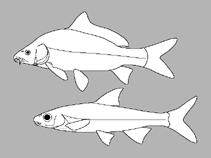
Épines dorsales (Total) : 3; Rayons mous dorsaux (Total) : 7; Épines anales: 3; Rayons mous anaux: 5; Vertèbres: 38 - 39. Sinocyclocheilus huizeensis can be distinguished by having the following unique characters: body normal; 70~73 lateral-line scales; 25~33 scales above lateral line; 9~12 scales below lateral line; 40~46 scales around caudal-peduncle; 5~6 gill rakers on the first gill arch; eyes normal, eye diameter 5.4%~7.2% of SL; interorbital width 3.6%~9.7% of SL; nostrils closer to preopercular margin than to snout tip; width between posterior nostrils 5.0%~7.3% of standard length; mouth inferior, its width 7.0%~9.3% of standard length, upper jaw length 7.0%~9.1% of standard length; superior angle of spiracle below level line of superior border of eyes; rostral barbels extending beyond the anterior margin of eyes, but not reaching posterior margin of operculum, maxillary barbels extending almost to posterior margin of preopercular; pectoral-fin length 16.8%~23.6% of standard length; last unbranched ray of dorsal fin thickened and hard, with serrations along posterior edge; 10 pelvic-fin branched rays; pelvic fin long, originating posterior to ventral line of dorsal-fin origin, stretching about 4/5 of the distance between pelvic-fin origin and anal-fin origin, reaching anus; pelvic fin narrow, axillary scales present (Ref. 110204).
Body shape (shape guide): fusiform / normal.
Cycle de vie et comportement reproducteur
Maturité | Reproduction | Frai | Œufs | Fécondité | Larves
Cheng, C., X. Pan, X. Chen, J. Li, L. Ma and J. Yang, 2015. A new species of the genus Sinocyclocheilus (Teleostei: Cypriniformes), from Jinshajiang drainage, Yunnan, China. Cave Research 1(2):1-4. (Ref. 110204)
Statut dans la liste rouge de l'IUCN (Ref. 130435: Version 2025-2 (Global))
Menace pour l'homme
Harmless
Utilisations par l'homme
Outils
Articles particuliers
Télécharger en XML
Sources Internet
Estimations basées sur des modèles
Indice de diversité phylogénétique (Réf.
82804): PD
50 = 0.5000 [Uniqueness, from 0.5 = low to 2.0 = high].
Bayesian length-weight: a=0.01122 (0.00526 - 0.02395), b=3.02 (2.84 - 3.20), in cm total length, based on LWR estimates for this (Sub)family-body shape (Ref.
93245).
Niveau trophique (Réf.
69278): 2.9 ±0.3 se; based on size and trophs of closest relatives
Résilience (Réf.
120179): Haut, temps minimum de doublement de population inférieur à 15 mois (Preliminary K or Fecundity.).
Vulnérabilité de la pêche (Ref.
59153): Low vulnerability (10 of 100).
🛈