>
Cypriniformes (Carps) >
Cyprinidae (Minnows or carps) > Smiliogastrinae
Etymology: laticeps: Name from the two Latin words 'latus' meaning wide and 'ceps' meaning headed, in reference to the wide head of the new fish.
Entorno: milieu / zona climática / rango de profundidad / gama de distribución
Ecología
; agua dulce bentopelágico. Tropical
Asia: Kerala, India.
Tamaño / Peso / Edad
Madurez: Lm ? range ? - ? cm
Max length : 13.0 cm SL macho / no sexado; (Ref. 112401)
Descripción breve
Claves de identificación | Morfología | Morfometría
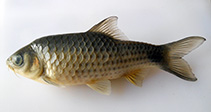
Radios blandos dorsales (total) : 11; Radios blandos anales: 8. Systomus laticeps is distinguished from all its congeners in having the following characters: elongated, round and wide body; small and wide head; hyaline fins; a prominent hump present on the post occipital region, convex post dorsal region, exceptionally soft and flexible operculum and body scales, a distinct thin median fontanel on the dorsal surface of head in between eyes and occiput; lateral line indistinct in the anterior and posterior regions; it is convex above anal fin origin; inter-radial membrane of anal fin fleshy, thick and prominent; and 27 lateral line scales and 9 predorsal scales (Ref. 112401)..
Body shape (shape guide): fusiform / normal.
Inhabits a small freshwater stream, formed by the confluence of certain branches of rivers flowing through the low level regions of Pathanamthitta District. This water body is 30- 37 m wide and <1 to 2 m deep during summer season and is blanketed by mud dominant sediments. This area has been covered by more or less dense riparian vegetation. Co-occurs with the following fish species: Puntius mahecola, Dawkinsia filamentosa, Haludaria fasciata, Rasbora dandia, Heteropneusteus fossilis, Clarias dussumeiri, Wallago attu, and Ompok malabaricus (Ref. 112401).
Ciclo vital y comportamiento de apareamiento
Madurez | Reproducción | Puesta | Huevos | Fecundidad | Larva
Plamoottil, M., 2016. Systomus laticeps, a new species of cyprinid fish from Kerala India. Intl. J. Fauna Biol. Stud. 3(5):92-96. (Ref. 112401)
Situación en la Lista Roja de la UICN (Ref. 130435: Version 2025-2 (Global))
Amenaza para el ser humano
Harmless
Usos humanos
Pesquerías: sin interés
Herramientas
Informes especiales
Descargar XML
Fuentes de Internet
Estimaciones basadas en modelos
Índice de diversidad filogenética (Referencia
82804): PD
50 = 0.5000 [Uniqueness, from 0.5 = low to 2.0 = high].
Bayesian length-weight: a=0.01072 (0.00504 - 0.02277), b=3.02 (2.84 - 3.20), in cm total length, based on LWR estimates for this (Sub)family-body shape (Ref.
93245).
Nivel trófico (Referencia
69278): 2.9 ±0.4 se; based on size and trophs of closest relatives
Resiliencia (Referencia
120179): Alto, población duplicada en un tiempo mínimo inferior a 15 meses (Preliminary K or Fecundity.).
Vulnerabilidad pesquera (Ref.
59153): Low vulnerability (10 of 100).
🛈