Elasmobranchi (squali e razze) (sharks and rays) >
Rhinopristiformes (Shovelnose rays) >
Rhinobatidae (Guitarfishes)
Etymology: omanensis: Named for its type locality, Oman.
Ambiente: milieu / zona climatica / distribuzione batimetrica / gamma di distribuzione
Ecologia
marino benthopelagico. Tropical; 27°N - 22°N, 56°E - 60°E (Ref. 114953)
Western Indian Ocean: Gulf of Oman.
Dimensione / Peso / Età
Maturità: Lm ? range ? - ? cm
Max length : 60.0 cm TL maschio/sesso non determinato; (Ref. 114953)
Breve descrizione
Chiavi di identificazione | Morfologia | Morfometria
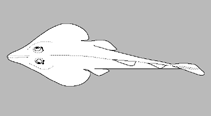
This small species has a wedge-shaped disc, is moderately elongate and with a narrow, triangular snout; anterior nasal flaps extending well across internasal space and are barely separated; dorsal surface with dense pattern of white ocelli; disc is rather thin, its length 1.3-1.4 times its width; anterior margins undulate, moderately concave before snout tip; outer corner of pectoral fins broadly rounded; snout angle ca. 64°; large eye, much larger than spiracles, orbit length 3.1-3.7 in preorbital length, 1.1-1.4 in interorbital space; rostral ridges well separated at the base; spiracle with 2 fleshy folds, inner fold rudimentary; rather large nostrils, oblique, length 1.2-1.3 times internasal space, anterior nasal flaps barely separated; velvety skin, entirely covered with minute denticles, no thorns nor thornlets, some barely enlarged denticles on preorbit and in median row between nape and first dorsal fin; tail 1.3-1.4 times longer than disc; tall dorsal fins widely spaced, interspace 2.7-3.2 times base length of first dorsal fin; apices angular to narrowly rounded; pectoral fin radials 67-72; total vertebral centra 185-188 (Ref. 114953).
Body shape (shape guide): elongated; Cross section: flattened.
Apparently a benthic species on inner continental shelf. Unknown life history. Maturity size unknown but a male was found mature at 50 cm TL (Ref. 114953).
Ciclo vitale e comportamento di accoppiamento
Maturità | Riproduzione | Deposizione | Uova | Fecondità | Larve
Last, P.R., W.T. White, M.R. de Carvalho, B. Séret, M.F.W. Stehmann and G.J.P. Naylor, 2016. Rays of the world. CSIRO Publishing, Comstock Publishing Associates. i-ix + 1-790. (Ref. 114953)
Stato della Lista Rossa IUCN (Ref. 130435: Version 2025-2 (Global))
Minaccia per l'uomo
Harmless
Usi umani
Strumenti
Rapporti speciali
Scarica XML
Fonti Internet
Stime basate su modelli
Indice di diversità filogenetica (Fonte Biblio.
82804): PD
50 = 0.5010 [Uniqueness, from 0.5 = low to 2.0 = high].
Bayesian length-weight: a=0.00295 (0.00150 - 0.00581), b=3.13 (2.96 - 3.30), in cm total length, based on LWR estimates for this (Sub)family-body shape (Ref.
93245).
Livello trofico (Fonte Biblio.
69278): 3.5 ±0.5 se; based on size and trophs of closest relatives
Resilienza (Fonte Biblio.
120179): Basso, tempo minimo di raddoppiamento della popolazione 4.5 - 14 anni (Preliminary low fecundity).
Vulnerabilità della pesca (Ref.
59153): Moderate vulnerability (44 of 100).
🛈