>
Galaxiiformes (Southern smelts) >
Galaxiidae (Galaxiids) > Galaxiinae
Etymology: Galaxias: Greek, galaxias, ou = a kind of fish (Ref. 45335); fuscus: Name from Latin 'fusc' meaning brown, dark, dusky or tawny, the author probably was referring to
the distinctive and dark bars on the sides of the body which he referred to as '...prominent dark oval blotches..' and the live colouration of the majority of this species is a dusky orange-brown, and the type material is currently also a tawny colour, hence the species name is apt.
Entorno: milieu / zona climática / rango de profundidad / gama de distribución
Ecología
; agua dulce bentopelágico; no migratorio (Ref. 98815); rango de profundidad 0 - 1 m (Ref. 98815). Subtropical
Oceania: endemic to the Goulburn River system in central Victoria, Australia.
Tamaño / Peso / Edad
Madurez: Lm ? range ? - ? cm
Max length : 16.5 cm FL macho / no sexado; (Ref. 98815); peso máximo publicado: 30.00 g (Ref. 98815); edad máxima reportada: 15 años (Ref. 98815)
Descripción breve
Claves de identificación | Morfología | Morfometría
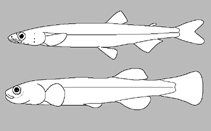
Radios blandos dorsales (total) : 8 - 12; Radios blandos anales: 9 - 12; Vértebra: 51 - 56. Galaxias fuscus is distinguished from all its congeners within the Galaxias olidus complex by a combination of the following characters: overall color ranging from dull to moderately bright orange, yellow-orange to reddish orange; body pattern generally absent except sides of trunk with a series of large, distinctive, dark bars surrounded by halos present, generally centered on the lateral line, relatively widely spaced and extending from above the pectoral fin base to above the pelvic fin base, very rarely faint blotches also on dorsal surface; dorsal surface of trunk broadly flattened anteriorly from above pelvic fin bases; caudal peduncle very deep (7.2-10.4 % SL); long caudal fin (12.1-19.2 % SL), much longer than caudal peduncle; long anal fin (14.2-18.6 % SL); large pectoral and pelvic fins (11.4-17.6 and 9.5-16.2 % SL, respectively); pelvic fins set far back (prepelvic length 53.4 % SL); large bulbous head, length 21.0-26.7 % SL and longer than pelvic fin to anal fin length, relatively wide and deep (56.7-75.6 and 35.5-53.3 % HL); nostrils short, not visible from ventral view; mouth large, with long upper and lower jaws (33.9-46.7 and 30.2-43.6 % HL respectively) and wide gape (34.3-53.9 % HL); most posterior extent of mouth about 0.8 ED below ventral margin of eye; 0-1 pyloric caecae, short (1.0 % SL) when present; and anal fin origin usually under 0.78 distance posteriorly along dorsal fin base (Ref. 98815).
Body shape (shape guide): elongated; Cross section: oval.
Facultative air-breathing in the genus (Ref. 126274); Occurs together with Galaxias olidus at one site (Raspberry Creek, Woods Point) though considered to have been sympatric with other populations before alien trout severely fragmented populations and substantially altered distributional patterns. Considered to have been historically sympatric with Galaxias arcanus and very possibly with Galaxias oliros at the very downstream extent of its range. Inhabits small to medium-sized (0.7-11.0 m average width), moderately to fast flowing, steep gradient, shallow (0.1-0.4 m average depth), creeks and rivers, all typically cool to cold. Stream substrate is composed of bedrock, boulder, cobble, with smaller amounts of pebble, gravel and sand. Streams are usually well shaded by dense overhanging riparian vegetation. Instream habitat usually has accumulations of large and small timber debris, rocks and tree roots in undercut banks. Forages off the bottom and mid water in pools and at the end of riffle/glide sections and feeds mostly on aquatic and terrestrial insects. Spawns from late September to early October, though males can be running ripe from about April, and females ripe from mid-June. Adults may live to around 15 years of age (Ref. 98815).
Ciclo vital y comportamiento de apareamiento
Madurez | Reproducción | Puesta | Huevos | Fecundidad | Larva
Raadik, T.A., 2014. Fifteen from one: a revision of the Galaxias olidus Günther, 1866 complex (Teleostei, Galaxiidae) in south-eastern Australia recognises three previously described taxa and describes 12 new species. Zootaxa 3898(1):001-198. (Ref. 98815)
Situación en la Lista Roja de la UICN (Ref. 130435: Version 2025-2 (Global))
Endangered (EN) (A3bce; B1ab(i,ii,iii,iv,v)+2ab(i,ii,iii,iv,v)); Date assessed: 14 February 2019
Amenaza para el ser humano
Harmless
Usos humanos
Herramientas
Informes especiales
Descargar XML
Fuentes de Internet
Estimaciones basadas en modelos
Índice de diversidad filogenética (Referencia
82804): PD
50 = 0.5000 [Uniqueness, from 0.5 = low to 2.0 = high].
Bayesian length-weight: a=0.00490 (0.00206 - 0.01165), b=3.12 (2.91 - 3.33), in cm total length, based on LWR estimates for this (Sub)family-body shape (Ref.
93245).
Nivel trófico (Referencia
69278): 3.2 ±0.5 se; based on size and trophs of closest relatives
Resiliencia (Referencia
120179): Alto, población duplicada en un tiempo mínimo inferior a 15 meses (Preliminary K or Fecundity.).
Vulnerabilidad pesquera (Ref.
59153): Low vulnerability (10 of 100).
🛈