>
Eupercaria/misc (Various families in series Eupercaria) >
Haemulidae (Grunts) > Plectorhinchinae
Etymology: Plectorhinchus: Greek, plektos = plaited + Greek, rhyngchos = snout (Ref. 45335); caeruleonothus: Name from the Latin words 'caeruleo' for blue and 'nothus' for bastard when combined as ‘Blue Bastard’ which has been commonly applied to this species by anglers for many years; referring to its blue sheen in life and difficulty to hook and land on artificial fly.
Περιβάλλον: περιβάλλον / κλιματική ζώνη / εύρος βάθους / εύρος διανομής
Οικολογία
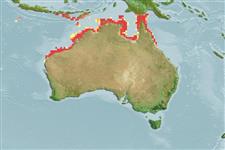
Θαλασσινό(ά) Υφαλόφιλο(α); εύρος βάθους 6 - 30 m (Ref. 103290). Tropical; 9°S - 25°S, 101°E - 147°E (Ref. 103290)
Southwest Pacific: Australia (Western Australia toi Queensland).
Μέγεθος / Βάρος / Ηλικία
Γεννητική Ωρίμανση: Lm ? range ? - ? cm
Max length : 100.0 cm TL αρσενικό/απροσδιόριστο; (Ref. 103290)
Σύντομη περιγραφή
Κλείδες προσδιορισμού | Μορφολογία | Μορφομετρία
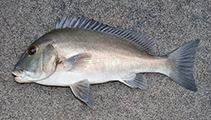
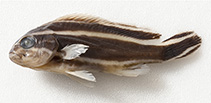
Ραχιαίες άκανθες (συνολικά) : 12; Μαλακές ραχιαίες ακτίνες (συνολικά) : 18 - 20; Εδρικές άκανθες: 3; Μαλακές εδρικές ακτίνες: 6 - 7. This species is distinguished by the following features: D XII, 18-20 (rarely 20); A III, 6-7 (rarely III, 6); pectoral-fin rays 16-17 (usually 17); lateral-line scales 56-61 (modally 59); transverse scale rows above lateral line 15; gill rakers 7-9 + 18-20 = 25-29 (modally 26); in juveniles, pelvic fins reaching anus, slightly short of anus in adults; nostrils minute, 0.4-0.8 % SL, 2-3 times in distance from posterior nostril to eye; when fresh colouration in adults with body uniformly silver-grey, cheek and opercles blue-grey, rim of orbit and dorsal edge of maxilla dusky yellow, posterior margin of opercular membrane silver-grey, non-contrasting with remainder of opercle and adjacent body (Ref. 103290).
Body shape (shape guide): fusiform / normal; Cross section: compressed.
This species is found on sand, rubble and reef bottom but mostly in the intertidal zone, or shallow reef; one specimen trawled in a depth of 30 m. The most southerly record is a large individual estimated to be 100 cm in total length. Large individuals are most often solitary, foraging diurnally over relatively open expanses of soft substrate. Agonistic behavioural interactions have been recorded between individuals, individuals have often been observed to interact highly aggressively, engaging in one-on-one conflicts (Ref. 103290).
Κύκλος ζωής και συμπεριφορά ζευγαρώματος
Γεννητική Ωρίμανση | Αναπαραγωγή | Γεννοβολία | Αβγά | Γονιμότητα | Προνύμφες
Johnson, J.W. and J.W. Wilmer, 2015. Plectorhinchus caeruleonothus, a new species of sweetlips (Perciformes: Haemulidae) from northern Australia and the resurrection of P. unicolor (Macleay, 1883), a species previously confused with P. schotaf (Forsskål, 1775). Zootaxa 3985(4):491-522. (Ref. 103290)
Κατάσταση Κόκκινου Καταλόγου IUCN (Ref. 130435: Version 2025-2 (Global))
Απειλή για τον άνθρωπο
Harmless
Ανθρώπινες χρήσεις
αλιεία: bycatch
Εργαλεία
Ειδικές εκθέσεις
Λήψη XML
Διαδικτυακές πηγές
Εκτιμήσεις βάσει μοντέλων
Δείκτης φυλογενετικής ποικιλότητας (Αναφ.
82804): PD
50 = 0.5000 [Uniqueness, from 0.5 = low to 2.0 = high].
Bayesian length-weight: a=0.01349 (0.00626 - 0.02905), b=3.00 (2.83 - 3.17), in cm total length, based on LWR estimates for this Genus-body shape (Ref.
93245).
Τροφικό Επίπεδο (Αναφ.
69278): 3.9 ±0.6 se; based on size and trophs of closest relatives
Ελαστικότητα (Αναφ.
120179): Πολύ χαμηλό, ελάχιστος χρόνος για διπλασιασμό πληθυσμού > 14 έτη (Preliminary K or Fecundity.).
Ευπάθεια στην αλιεία (Ref.
59153): High vulnerability (60 of 100).
🛈
Θρεπτικά συστατικά (Ref.
124155): Calcium = 21.8 [8.7, 40.3] mg/100g; Iron = 0.445 [0.233, 0.856] mg/100g; Protein = 19.4 [17.5, 21.3] %; Omega3 = 0.106 [0.058, 0.178] g/100g; Selenium = 36.5 [20.4, 62.3] μg/100g; VitaminA = 57.3 [21.5, 147.8] μg/100g; Zinc = 0.964 [0.681, 1.396] mg/100g (wet weight);