Classification / Noms
Noms communs | Synonymes | Catalog of Fishes(Genre, Espèce) | ITIS | CoL | WoRMS | Cloffa
>
Eupercaria/misc (Various families in series Eupercaria) >
Sparidae (Porgies)
Etymology: Diplodus: Greek, diploos = twice + Greek, odous = teeth (Ref. 45335); levantinus: Namerefers to the Levant, a historical name for the coasts of the eastern Mediterranean.
Environnement : milieu / zone climatique / profondeur / gamme de distribution
Écologie
marin récifal; profondeur 0 - 50 m (Ref. 110175). Subtropical; 34°N - 32°N, 34°E - 35°E (Ref. 110175)
Distribution
Territoires | Zones FAO | Écosystèmes | Occurrences | Carte par point | Introductions | Faunafri
Eastern Mediterranean: Israel.
Taille / Poids / Âge
Maturité: Lm ? range ? - ? cm
Max length : 26.2 cm TL mâle / non sexé; (Ref. 132388); poids max. publié: 299.00 g (Ref. 132388)
Description synthétique
Clés d'identification | Morphologie | Morphométrie
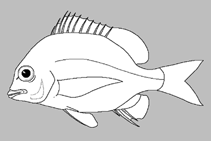
Épines dorsales (Total) : 11 - 12; Rayons mous dorsaux (Total) : 10 - 16; Épines anales: 3; Rayons mous anaux: 11 - 13; Vertèbres: 23. This species is distinguished by the following characters: D XI-XII,10-16; A III,11-13; pectoral fin rays 15-17; gill rakers on first gill arch 6-9 + 8-12; upper and lower jaws with a single row of 4 incisors on each side, followed by molariform teeth, total of 16-19 in the upper jaw and 12-14 in the lower jaw, with the molariforms of the upper jaw separated from the incisors by a wide gap; in adults, sides of the body with 8 vertical bars of equal width, also present even in large adults, followed by a broad bar on caudal peduncle, which usually nearly reaches the ventral margin of the caudal peduncle (Ref. 110175).
Body shape (shape guide): short and / or deep; Cross section: compressed.
Found from shallow water to 50 m depth, usually on sand bottom near rocks; while juveniles are found above sandy substrate near rocks at depths of 0.2-2 m (Ref. 110175).
Cycle de vie et comportement reproducteur
Maturité | Reproduction | Frai | Œufs | Fécondité | Larves
Fricke, R., D. Golani and B. Appelbaum-Golani, 2016. Diplodus levantinus (Teleostei: Sparidae), a new species of sea bream from the southeastern Mediterranean Sea of Israel, with a checklist and a key to the species of the Diplodus sargus species group. Scientia Marina 80(3):1-16. (Ref. 110175)
Statut dans la liste rouge de l'IUCN (Ref. 130435: Version 2025-2 (Global))
Menace pour l'homme
Harmless
Utilisations par l'homme
Outils
Articles particuliers
Télécharger en XML
Sources Internet
Estimations basées sur des modèles
Indice de diversité phylogénétique (Réf.
82804): PD
50 = 0.5000 [Uniqueness, from 0.5 = low to 2.0 = high].
Bayesian length-weight: a=0.01479 (0.00830 - 0.02636), b=2.94 (2.79 - 3.09), in cm total length, based on LWR estimates for this species & (Sub)family-body (Ref.
93245).
Niveau trophique (Réf.
69278): 3.1 ±0.5 se; based on size and trophs of closest relatives
Résilience (Réf.
120179): Milieu, temps minimum de doublement de population : 1,4 à 4,4 années (Preliminary K or Fecundity.).
Vulnérabilité de la pêche (Ref.
59153): Low vulnerability (16 of 100).
🛈