Classificatie / Namen
Lokale namen | Synoniemen | Catalog of Fishes(Genus, Soort(en)) | ITIS | CoL | WoRMS | Cloffa
>
Cichliformes (Cichlids, convict blennies) >
Cichlidae (Cichlids) > Pseudocrenilabrinae
Etymology: Julidochromis: Taken from marine wrasse "julidini"; also from Greek, ioulis = a fish dealing with genera Coris or Thalassoma (Ref. 45335); marksmithi: Named for Mark Smith, who was instrumental in obtaining the specimens used in this description and providing the photograph of the living species of Julidochromis (Ref. 115482).
Eponymy: Mark Smith is an American aquarist who specialises in Rift Valley cichlids. He is also a photographer of aquatic wildlife, an explorer and a writer. Among his books is: Lake Malawi Cichlids (2001). (Ref. 128868), visit book page.
Milieu: milieu / Klimaatzone / Diepte / verspreidingsgebied
Ecologie
; zoet water pelagisch. Tropical
Africa: endemic to the Tanzanian coast of Lake Tanganyika in the area around Kipili (Ref. 115482).
Grootte / Gewicht / Leeftijd
Maturiteit: Lm ? range ? - ? cm
Max length : 6.3 cm SL mannelijk / geslacht onbekend; (Ref. 115482)
Korte beschrijving
Determinatiesleutels | Morfologie | Morfometrie
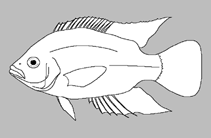
Dorsale stekels (totaal) : 21 - 23; Dorsale zachte stralen (totaal) : 5 - 7; Anale stekels: 6 - 8; Anale zachte stralen: 5 - 7. Diagnosis: Julidochromis marksmithi is a typical Julidochromis that differs mainly in its colouration and pattern from the other species of the genus: it is bright yellow and decorated by two major horizontal dark brown to blackish bands on the body with a third stripe extending from the nape only about halfway along the back at the dorsal fin base; an additional dark somewhat irregular stripe (cheek stripe) runs from the corner of the mouth across the cheek as far as the pectoral fin base , but the posterior segments beyond the preopercle are often faded or lacking; this stripe is lacking in the ornatus-transcriptus-dickfeldi group; a broad dark band, bordered by a narrow blackish edge and a submarginal light blue stripe, extends along the upper part of the dorsal fin to its angle where it may spread throughout the soft portion of the fin (Ref. 115482). It differs from the larger J. regani and J. marlieri by lacking the lower body band of those species, and all their forms; Julidochromis ornatus has a blackish band, often quite broad, running along the entire base of the dorsal fin with the remainder of the fin yellow, no black band is present along the upper part of the fin; Julidochromis dickfeldi also lacks the cheek stripe as well as the band in the dorsal fin; it is white below the central body band as opposed to the yellow in J. marksmithi; Julidochromis marlieri and J. transcriptus have vertical bars, which are absent in J. marksmithi (Ref. 115482).
Body shape (shape guide): elongated.
It is found in a rocky habitat but where there are sandy areas close by (Ref. 115482).
Levenscyclus en paargedrag
Maturiteit | Voortplanting | Paaien | Eieren | Fecunditeit | Larven
Burgess, W.E., 2014. Julidochromis marksmithi a new species of Julidochromis from the Tanzanian coast of Lake Tanganyika. Tanganika Mag. 15:40-49. (Ref. 115482)
Status op de Rode Lijst van het IUCN (Ref. 130435: Version 2025-2 (Global))
Gevaar voor de mens
Harmless
Gebruik door de mens
Tools
Speciale rapporten
Download XML
Internetbronnen
Schattingen op basis van modellen
Fylogenetische diversiteitsindex (Ref.
82804): PD
50 = 0.5156 [Uniqueness, from 0.5 = low to 2.0 = high].
Bayesian length-weight: a=0.00389 (0.00180 - 0.00842), b=3.12 (2.94 - 3.30), in cm total length, based on all LWR estimates for this body shape (Ref.
93245).
Trofisch niveau (Ref.
69278): 3.4 ±0.4 se; based on size and trophs of closest relatives
Weerstandsvermogen (Ref.
120179): Hoog, minimale populatieverdubbelingstijd minder dan 15 maanden (Preliminary K or Fecundity.).
Kwetsbaarheid van de visserij (Ref.
59153): Low vulnerability (10 of 100).
🛈