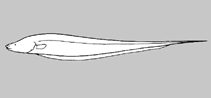
Clasificación / Nombres
Nombres comunes | Sinónimos | Catalog of Fishes(Género, Especie) | ITIS | CoL | WoRMS | Cloffa
>
Gymnotiformes (Knifefishes) >
Sternopygidae (Glass knifefishes) > Eigenmanninae
Etymology: Eigenmannia: From Eigenmann, 1910, researcher of faunistic studies (Ref. 45335); antonioi: The epithet antonioi is in memory to Antônio da Silva Wanderley, grandfather of the first author (Ref. 115689).
Eponymy: Professor Dr Carl Henry Eigenmann (1863–1927) was a German-born American ichthyologist. [...] Antônio da Silva Wanderley was the first author’s grandfather. (Ref. 128868), visit book page.
Entorno: milieu / zona climática / rango de profundidad / gama de distribución
Ecología
; agua dulce bentopelágico. Tropical
South America: known only from Rio Anapu at Floresta Nacional de Caxiuanã, a tributary of the lower portion of Rio Amazonas, state of Pará, Brazil (Ref. 115689).
Tamaño / Peso / Edad
Madurez: Lm ? range ? - ? cm
Max length : 20.5 cm TL macho / no sexado; (Ref. 115689)
Descripción breve
Claves de identificación | Morfología | Morfometría
Radios blandos anales: 166 - 207. Diagnosis: can be distinguished from other species in the E. trilineata species group, except E. microstoma and E. trilineata, by the mouth width 20.0–25.1% HL (versus 13.1–18.4% in E. desantanai; 12.9–17.5% in E. guairaca; 12.6–16.1% in E. matintapereira; 13.2–18.1% in E. muirapinima; 10.8–19.0 in E. pavulagem; 9.5–17.2% in E. vicentespelaea; and 9.5–14.6% in E. waiwai); Eigenmannia antonioi differs from E. microstoma and E. trilineata by the suborbital depth 18.4–27.8% HL (versus 29.9–40.8% and 32.5–46.6%, respectively); by the dentition pattern of the premaxilla with 8 to 12 teeth distributed in 2 rows (outermost row with 3 to 6 teeth, innermost row with 4 to 6 teeth) [versus 16 teeth distributed in 3 rows (outermost row with 5 teeth, median row with 6, innermost with 5 teeth) in E. microstoma, and the 31–33 teeth distributed in 4 rows (outermost row with 8 or 9 teeth, 2nd row with 5 or 6, 3rd row with 10; innermost with 7 or 9 teeth) in E. trilineata] and by the length of anterodorsal process of maxillary corresponding to 50% of the width of the posterior nostril (versus equal to the width of the posterior nostril in E. trilineata and E. microstoma); Eigenmannia antonioi can be further distinguished from E. microstoma by the length of the coronomeckelian bone 20% of the length of Meckel’s cartilage (versus 45% of the length of Meckel’s cartilage in E. microstoma); distinguished from E. trilineata by the depth of the posterodorsal expansion on infraorbitals 1 + 2, which approximately equals the total length of infraorbitals 1 + 2 (versus less than 50% of the length of infraorbitals 1 + 2 in E. trilineata), and by 8 or 9 endopterygoid teeth (versus 17 in E. trilineata) (Ref. 115689).
Body shape (shape guide): elongated.
Ciclo vital y comportamiento de apareamiento
Madurez | Reproducción | Puesta | Huevos | Fecundidad | Larva
Peixoto, L.A.W., G.M. Dutra and W.B. Wosiacki, 2015. The electric glass knifefishes of the Eigenmannia trilineata species-group (Gymnotiformes: Sternopygidae): monophyly and description of seven new species. Zool. J. Linn. Soc. 175:384-414. (Ref. 115689)
Situación en la Lista Roja de la UICN (Ref. 130435: Version 2025-2 (Global))
Amenaza para el ser humano
Harmless
Usos humanos
Pesquerías: sin interés
Herramientas
Informes especiales
Descargar XML
Fuentes de Internet
Estimaciones basadas en modelos
Índice de diversidad filogenética (Referencia
82804): PD
50 = 0.5000 [Uniqueness, from 0.5 = low to 2.0 = high].
Bayesian length-weight: a=0.00355 (0.00161 - 0.00782), b=2.97 (2.78 - 3.16), in cm total length, based on LWR estimates for this (Sub)family-body shape (Ref.
93245).
Nivel trófico (Referencia
69278): 3.1 ±0.3 se; based on size and trophs of closest relatives
Vulnerabilidad pesquera (Ref.
59153): Low vulnerability (10 of 100).
🛈