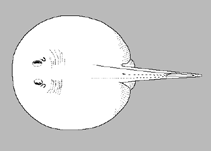
Potamotrygon jabuti

You can sponsor this page

Potamotrygon jabuti Carvalho, 2016

Envoyez vos Photos et vidéos
Images Google
Image of Potamotrygon jabuti
No image available for this species;
drawing shows typical species in Potamotrygonidae.

Classification / Noms Noms communs | Synonymes | Catalog of Fishes(Genre, Espèce) | ITIS | CoL | WoRMS | Cloffa

Élasmobranches (requins et raies) (sharks and rays) > Myliobatiformes (Stingrays) > Potamotrygonidae (River stingrays) > Potamotrygoninae
Etymology: Potamotrygon: Greek, potamos = river + Greek, trygon = a sting ray (Ref. 45335).

Environnement : milieu / zone climatique / profondeur / gamme de distribution Écologie

; eau douce benthopélagique. Tropical

Distribution Territoires | Zones FAO | Écosystèmes | Occurrences | Carte par point | Introductions | Faunafri

South America: Rio Tapajós basin, Brazil.

Taille / Poids / Âge

Maturité: Lm ?  range ? - ? cm

Description synthétique Clés d'identification | Morphologie | Morphométrie

Potamotrygon jabuti is distinguished by the following characters: marbled color pattern that undergoes remarkable change with growth as adults have elaborate designs of beige, golden to yellowish-orange spots or ocelli surrounded by a slender beige to golden mesh-like pattern, but neonates have simple, well-separated ocelli; a single to double row of tail thorns varying in their development; monognathic heterodonty with teeth of intermediate lateral rows of upper jaws larger and hexagonal; and two robust, more or less equally developed angular cartilages (Ref. 115937).

Biologie     Glossaire (ex. epibenthic)

Cycle de vie et comportement reproducteur Maturité | Reproduction | Frai | Œufs | Fécondité | Larves

Référence principale Téléchargez vos références | Références | Coordinateur : Carvalho, Marcelo | Collaborateurs

de Carvalho, M.R., 2016. Description of two extraordinary new species of freshwater stingrays of the genus Potamotrygon endemic to the rio Tapajós basin, Brazil (Chondrichthyes: Potamotrygonidae), with notes on other Tapajós stingrays. Zootaxa 4167(1):1-63. (Ref. 115937)

Statut dans la liste rouge de l'IUCN (Ref. 130435: Version 2025-2 (Global))

  Menacé (EN) (A2cd); Date assessed: 18 August 2022

CITES


CMS (Ref. 116361)

Not Evaluated

Menace pour l'homme

  Harmless


Utilisations par l'homme

FAO - Publication: search | FishSource |

Plus d'informations

Écologie trophique
Aliments (proies)
Composition du régime alimentaire
Consommation alimentaire
Rations alimentaires
Prédateurs
Écologie
Écologie
Dynamique des populations
Paramètres de croissance
Âges / tailles maximales
Longueur-poids rel.
Rel. longueur-longueur.
Fréquences de longueurs
Conversion de masse
Recrutement
Abondance
Cycle de vie
Reproduction
Maturité
Maturité/épines rel.
Fécondité
Frai
Agrégats de frai
Œufs
Développement de l'œuf
Larves
Dynamique des populations larvaires
Distribution
Territoires
Zones FAO
Écosystèmes
Occurrences
Introductions
BRUVS - Vidéos
Anatomie
Surface branchiale
Cerveau
Otolithe
Physiologie
Composition corporelle
Nutriments
Consommation d'oxygène
Type de natation
Vitesse de nage
Pigments visuels
Son de poisson
Maladies et parasites
Toxicité (CL50)
Génétique
génôme
Génétique
Hétérozygotie
Héritabilité
Diversité génétique
Liées à l'homme
Systèmes d'aquaculture
Profils d'aquaculture
Souches
Cas de ciguatera
Timbres, pièces de monnaie, divers
Sensibilisation
Collaborateurs
Taxonomie
Noms communs
Synonymes
Morphologie
Morphométrie
Images
Références
Références

Outils

Articles particuliers

Télécharger en XML

Sources Internet

AFORO (otoliths) | Aquatic Commons | BHL | Cloffa | Websites from users | FishWatcher | CISTI | Catalog of Fishes: Genre, Espèce | DiscoverLife | ECOTOX | FAO - Publication: search | Faunafri | Fishipedia | Fishtrace | GloBI | Google Books | Google Scholar | Google | IGFA World Record | OneZoom | Open Tree of Life | Otolith Atlas of Taiwan Fishes | Aquariums publics | PubMed | Reef Life Survey | Socotra Atlas | TreeBase | Arbre de Vie | Wikipedia: aller à, chercher | World Records Freshwater Fishing | Zoobank | Zoological Record

Estimations basées sur des modèles

Indice de diversité phylogénétique (Réf. 82804):  PD50 = 0.5000   [Uniqueness, from 0.5 = low to 2.0 = high].
Bayesian length-weight: a=0.01000 (0.00244 - 0.04107), b=3.04 (2.81 - 3.27), in cm total length, based on all LWR estimates for this body shape (Ref. 93245).
Niveau trophique (Réf. 69278):  3.2   ±0.4 se; based on size and trophs of closest relatives
Vulnérabilité de la pêche (Ref. 59153):  High vulnerability (58 of 100). 🛈