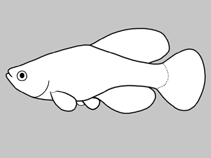
Klassifizierung / Names
Namen | Synonyme | Catalog of Fishes(Gattung, Arten) | ITIS | CoL | WoRMS | Cloffa
>
Cyprinodontiformes (Rivulines, killifishes and live bearers) >
Nothobranchiidae (African rivulines)
Etymology: Nothobranchius: Greek, nothos = false + Greek, brangchia = gill (Ref. 45335); capriviensis: The species name capriviensis represents a toponym after the Caprivi Strip, the historical name for the narrow extension of northeastern Namibia, where this species occurs; this part of Namibia was originally named after the German statesman Count Leo von Caprivi (Ref. 116076).
Umwelt: Milieu / Klimazone / Tiefenbereich / Verbreitungsgebiet
Ökologie
; süßwasser pelagisch. Tropical
Africa: eastern part of the Zambezi Region of Namibia (Ref. 116076).
Größe / Gewicht / Alter
Geschlechtsreife: Lm ? range ? - ? cm
Max length : 5.0 cm SL Männchen/unbestimmt; (Ref. 116076)
Kurzbeschreibung
Bestimmungsschlüssel | Morphologie | Morphometrie
Rückenflossenstacheln (insgesamt) : 0; Rückenflossenweichstrahlen (insgesamt) : 15 - 18; Afterflossenstacheln: 0; Afterflossenweichstrahlen: 16 - 18. Diagnosis: Nothobranchius capriviensis is known only as blue form, in contrast to N. kafuensis, its closest relative, that occurs as red, blue and intermediate forms; while there are general similarities in male colouration between N. capriviensis and the blue form of N. kafuensis, there are also consistent differences: the male N. capriviensis can be distinguished by the paler shade of blue than the blue phenotype of N. kafuensis, the lack of orange-red scale margins and the orange-red colour on the head of the latter species, and a more prominent and consistent barring on the body of the former; differences in female colouration are not as obvious: scale centers of N. capriviensis are iridescent light blue, whereas those of female N. kafuensis are less prominently blue and have a silver hue (Ref. 116076). Morphologically and meristically, the male N. capriviensis differs from that of N. kafuensis by a deeper body, its mean 35.4% of standard length vs. 31.4%, longer head, its mean 32.5% of standard length vs. 30.7%, a more posterior position of the anal fin, pre-anal length 62.3% of standard length vs. 60.5%, and a higher number of scales around the caudal peduncle, 14-16 vs. 13-14; female N. capriviensis have a more posterior position of the anal fin, pre-anal length 63.9% of standard length vs. 66.8%, when compared with N. kafuensis
Body shape (shape guide): fusiform / normal.
Found in large, relatively shallow ephemeral pools, which dry up completely on a seasonal basis (Ref. 116076). Eggs deposited in the mud substrate by the adult fish survive therein through the dry season, experiencing a number of phases of development with intervening diapauses; the eggs then hatch at the onset of the rainy season; growth of the fry is rapid and sexual maturity may be attained within four to six weeks (Ref. 116076).
Lebenszyklus und Paarungsverhalten
Geschlechtsreife | Fortpflanzung | Ablaichen | Eier | Fruchtbarkeit | Larven
Watters, B.R., R.H. Wildekamp and K.M. Shidlovskiy, 2015. Description and biogeography of Nothobranchius capriviensis, a new species of annual killifish from the Zambezi Region of Namibia (Cyprinodontiformes: Nothobranchiidae). J. Am. Killifish Ass. 47(4-6):97-133. (Ref. 116076)
IUCN Rote Liste Status (Ref. 130435: Version 2025-2 (Global))
Bedrohung für Menschen
Harmless
Nutzung durch Menschen
Tools
Zusatzinformationen
Download XML
Internet Quellen
Schätzungen auf der Grundlage von Modellen
Phylogenetischer Diversitätsindex (Ref.
82804): PD
50 = 0.5000 [Uniqueness, from 0.5 = low to 2.0 = high].
Bayesian length-weight: a=0.00603 (0.00250 - 0.01453), b=3.13 (2.93 - 3.33), in cm total length, based on LWR estimates for this (Sub)family-body shape (Ref.
93245).
Trophische Ebene (Ref.
69278): 3.2 ±0.4 se; based on size and trophs of closest relatives
Anfälligkeit der Fischerei (Ref.
59153): Low vulnerability (10 of 100).
🛈