>
Gobiiformes (Gobies) >
Gobiidae (Gobies) > Gobiinae
Etymology: Grallenia: Named for Gerald R. Allen, (G+R+Allen+suffix '-ia'), in honor of his great contribution to our knowledge of the diversity of coral-reef fishes; lauensis: Named for its type locality, Lau Archipelago.
Eponymy: Dr Gerald Ray Allen (d: 1942) The genus was named to honour “…his great contribution to our knowledge of the diversity of coral-reef fishes.” (See Allen, GR) (Ref. 128868), visit book page.
Ambiente: milieu / zona climatica / distribuzione batimetrica / gamma di distribuzione
Ecologia
marino associati a barriera corallina; distribuzione batimetrica 30 - 35 m (Ref. 116128). Tropical
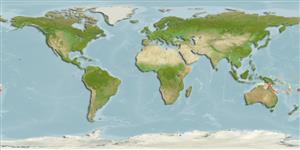
Western Pacific: Fiji and Australia (Great Barrier Reef and northwestern Coral Sea).
Dimensione / Peso / Età
Maturità: Lm ? range ? - ? cm
Max length : 1.6 cm SL maschio/sesso non determinato; (Ref. 116128); 1.1 cm SL (female)
Breve descrizione
Chiavi di identificazione | Morfologia | Morfometria
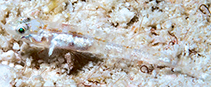
Spine dorsali (totale) : 7; Raggi dorsali molli (totale) : 7; Spine anali: 1; Raggi anali molli: 7; Vertebre: 27. This species is distinguished by the following characters: D VI + I,7; A I,7; all segmented dorsal- and anal-fin rays are unbranched; pectoral-fin rays 15, all rays unbranched except the middle 2-4; posterior longitudinal scales 8-12, mainly restricted to caudal peduncle; no scales on anterior body; body depth at pelvic-fin origin 15.1-15.7% SL; depth at anal-fin origin 12.9-13.2% SL; with cephalic sensory-canal pores; live colour of female mainly translucent with faint markings, including 5, progressively shorter, orange-brown, dash-like marks overlying vertebral column, about 10-12 narrow orange bars on the back between level of pectoral-fin base and caudal-fin base, and 5-6 widely-spaced, brown-to-orange spots on lower side between middle of abdomen and caudal-fin base; male colour unknown (Ref. 116128).
Body shape (shape guide): elongated; Cross section: oval.
Inhabits area of extensive gradual slopes of clean white sand (in 30-35 m depth). Collected from sites located in channel passes from the outer reef to extensive inner lagoons, and were hence subject to frequent strong currents and high rates of water exchange (Ref. 116128).
Ciclo vitale e comportamento di accoppiamento
Maturità | Riproduzione | Deposizione | Uova | Fecondità | Larve
Allen, G.R. and M.V. Erdmann, 2017. Descriptions of five new species of marine gobies (Teleostei: Gobiidae) of the genus Grallenia) from the tropical western Pacific Ocean. J. Ocean Sci. Found. 27:20-47. (Ref. 116128)
Stato della Lista Rossa IUCN (Ref. 130435: Version 2025-2 (Global))
Minaccia per l'uomo
Harmless
Usi umani
Strumenti
Rapporti speciali
Scarica XML
Fonti Internet
Stime basate su modelli
Indice di diversità filogenetica (Fonte Biblio.
82804): PD
50 = 0.5020 [Uniqueness, from 0.5 = low to 2.0 = high].
Bayesian length-weight: a=0.00741 (0.00347 - 0.01582), b=3.09 (2.91 - 3.27), in cm total length, based on LWR estimates for this (Sub)family-body shape (Ref.
93245).
Livello trofico (Fonte Biblio.
69278): 3.0 ±0.3 se; based on size and trophs of closest relatives
Resilienza (Fonte Biblio.
120179): Alto, tempo minimo di raddoppiamento della popolazione meno di 15 mesi (Preliminary K or Fecundity.).
Vulnerabilità della pesca (Ref.
59153): Low vulnerability (10 of 100).
🛈