Classification / Noms
Noms communs | Synonymes | Catalog of Fishes(Genre, Espèce) | ITIS | CoL | WoRMS | Cloffa
Myxines (hagfishes) >
Myxiniformes (Hagfishes) >
Myxinidae (Hagfishes) > Eptatretinae
Etymology: Eptatretus: hepta (Gr.), seven; tretos (Gr.), perforated (i.e., with holes), referring to seven gill apertures on what would later be described as Homea banksii (=E. cirrhatus) [range within genus is 6-14 pairs of gill apertures] (See ETYFish); aceroi: In honor of marine biologist Arturo Acero Pizarro (b. 1954), Universidad Nacional de Colombia, for his “curiosity about, and important contributions to, the study of Colombian marine fishes” (See ETYFish).
Eponymy: Dr Arturo Acero Pizarro (d: 1954) is Associate Professor (1986–2018) at the Universidad Nacional de Colombia. [...] (Ref. 128868), visit book page.
Environnement : milieu / zone climatique / profondeur / gamme de distribution
Écologie
marin bathydémersal; profondeur ? - 705 m (Ref. 103732). Tropical
Caribbean: Colombia.
Taille / Poids / Âge
Maturité: Lm ? range ? - ? cm
Max length : 58.4 cm TL mâle / non sexé; (Ref. 103732)
Description synthétique
Clés d'identification | Morphologie | Morphométrie
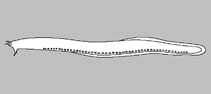
This species is distinguished from all its congeners by the following characters: it is the most slender species in the genus with a depth at the pharyngocutaneous duct (PCD) of 2.4% TL (vs. range of 2.9-15.3% TL), and with 174 total slime pores (vs. 60-130) (Ref. 103732).
Body shape (shape guide): eel-like; Cross section: oval.
Collected from an area with clams and mussels of the families Solemyidae, Vesicomydae, Lucinidae, and Thyasiridae, along with empty tubes of vestimentiferan polychaetes of the family Siboglinidae which are typical chemosymbiotic metazoans observed at methane seep sites. Also the geological characteristics of the area, such as accretionary prisms that favor cold seep formation, suggest the tolerance of this species to this habitat. (Ref. 103732).
Cycle de vie et comportement reproducteur
Maturité | Reproduction | Frai | Œufs | Fécondité | Larves
Fernandez, A.P. and B. Fernholm, 2014. A new species of hagfish (Myxinidae: Eptatretus) from the Colombian Caribbean. Copeia 2014(3):530-533. (Ref. 103732)
Statut dans la liste rouge de l'IUCN (Ref. 130435: Version 2025-2 (Global))
Menace pour l'homme
Harmless
Utilisations par l'homme
Pêcheries: sans intérêt
Outils
Articles particuliers
Télécharger en XML
Sources Internet
Estimations basées sur des modèles
Indice de diversité phylogénétique (Réf.
82804): PD
50 = 0.5000 [Uniqueness, from 0.5 = low to 2.0 = high].
Bayesian length-weight: a=0.00204 (0.00094 - 0.00444), b=2.92 (2.72 - 3.12), in cm total length, based on LWR estimates for this (Sub)family-body shape (Ref.
93245).
Niveau trophique (Réf.
69278): 4.2 ±0.7 se; based on size and trophs of closest relatives
Résilience (Réf.
120179): Milieu, temps minimum de doublement de population : 1,4 à 4,4 années (Preliminary K or Fecundity.).
Vulnérabilité de la pêche (Ref.
59153): Moderate vulnerability (43 of 100).
🛈