Elasmobranchii (tubarões e raias) (sharks and rays) >
Squaliformes (Sleeper and dogfish sharks) >
Squalidae (Dogfish sharks)
Etymology: Squalus: Genus name from Latin 'squalus' meaning shark (Ref. 6885, 27436); mahia: Name from Malagasy 'mahia' meaning skinny or very thin, referring to the particular morphological
features of this species; noun in apposition.
Taxonomic Remarks
Species information for completion.
Meio ambiente: milieu / Zona climática / intervalo de profundidade / faixa de distribuição
Ecologia
marinhas pelagic-oceanic; intervalo de profundidade 55 - 500 m (Ref. 116247), usually 202 - 390 m (Ref. 116247). Tropical
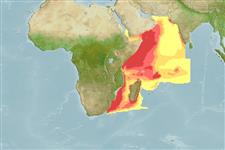
Western Indian Ocean: restricted distribution from Socotra Islands and northern Madagascar to Algoa Bay, Eastern Cape in South Africa.
Tamanho / Peso / Idade
Maturidade: Lm ? range ? - ? cm
Max length : 50.0 cm TL macho/indeterminado; (Ref. 116247); 59.0 cm TL (female)
Descrição suscinta
Chaves de identificação | Morfologia | Morfometria
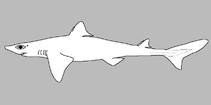
This species is distinguished from its congeners by the following characters: a slender body with a narrow caudal fin, pointed dorsal and ventral caudal tips, and dermal dentils with markedly slender crowns; it is clearly distinct from its regional congeners S. acanthias, S. acutipinnis, Squalus cf. blainvillei, Squalus cf. mitsukurii, S. megalops, by having a ventral caudal lobe which is mostly white with a black caudal blotch near lower caudal origin; differs from S. megalops by having a more elongated first dorsal fin spine, with length 4.9% TL (4.2-5.1%) and corresponding to 0.6 (0.5-0.7) times the height of first dorsal fin in adult specimens (vs. 2.7-3.7% TL, 0.3-0.4 times in S. megalops), slender and upright dorsal fins (vs. wide and low), postventral caudal margins not uniformly white (vs. uniformly white); it differs from S. brevirostris and S. acanthias by its greater preoral length, its length 9.5-11.1% TL (vs. 8.5-9.1% TL for brevirostris and 8.3-9.2% TL for acanthias); differs from S. brevirostris and S. crassispinus by the thickness of its first dorsal fin spine of adults, base length 0.8-1.0% TL (vs. 0.5-0.7% TL for brevirostris and 1.1-1.3% TL for crassispinus); adults of Squalus mahia differs from S. acanthias and S. crassispinus by its first dorsal fin anterior margin length 10.5-12.2% TL (vs. 6.8-9.8% TL for acanthias and 12.6-12.9% TL for crassispinus); differs from S. acanthias and S. margaretsmithae by its greater prespiracular length. 12.4-13.7% TL (vs. 10.7-12.0% TL for acanthias and 11.5-12.3% TL for margaretsmithae); differs from S. chloroculus, S. edmundsi, S. lalannei, S. mitsukurii, S. montalbani, S. nasutus by having a smaller snout with prenarial length shorter than distance from nostril to upper labial furrow, and unicuspid and lanceolate dermal dentils (vs. prenarial length greater than distance from nostril to upper labial furrow, and tricuspid and rhomboid dermal dentils) (Ref. 116247).
Body shape (shape guide): elongated.
A mesopelagic species, where its distribution indicates that it is a warmer-water species
associated with the Mozambique and Agulhas currents (Ref. 116247).
Ciclo de vida ou comportamento de acasalamento
Maturidade | Reprodução | Desova | Ovos | Fecundidade | Larvas
Viana, S.T. d. F.L., M.W. Lisher and M.R. de Carvalho, 2017. Two new species of short-snouted dogfish sharks of the genus Squalus Linnaeus, 1758, from southern Africa (Chondrichthyes: Squaliformes: Squalidae). Mar. Biodiv. 1-28. (Ref. 116247)
Status na Lista Vermelha da UICN (Ref. 130435: Version 2025-2 (Global))
Ameaça para os humanos
Harmless
Uso pelos humanos
Pescarias: de interesse potencial
Ferramentas
Relatórios especiais
Baixar XML
Fontes da internet
Estimativas baseadas em modelos
Índice de diversidade filogenética (Ref.
82804): PD
50 = 0.5000 [Uniqueness, from 0.5 = low to 2.0 = high].
Bayesian length-weight: a=0.00347 (0.00163 - 0.00737), b=3.09 (2.92 - 3.26), in cm total length, based on LWR estimates for this Genus-body shape (Ref.
93245).
Nível Trófico (Ref.
69278): 4.2 ±0.3 se; based on size and trophs of closest relatives
Resiliência (Ref.
120179): Baixo, tempo mínimo de duplicação da população 4,5 - 14 anos (Preliminary K or Fecundity.).
Vulnerabilidade da pesca (Ref.
59153): Moderate vulnerability (44 of 100).
🛈