Klassifizierung / Names
Namen | Synonyme | Catalog of Fishes(Gattung, Arten) | ITIS | CoL | WoRMS | Cloffa
>
Siluriformes (Catfishes) >
Mochokidae (Squeakers or upside-down catfishes) > Chiloglanidinae
Etymology: Chiloglanis: Greek, cheilos = lip + Greek, glanis = a fish that can eat the bait without touching the hook; a cat fish (Ref. 45335); camarabounyi: The specific epithet is used as a noun in apposition and refers to Camara-Bounyi, the name of the village adjacent to the type locality; the residents of the village generously allowed access to the type locality, assisted with the collection, and the children provided common names for the species (Ref. 116018).
Umwelt: Milieu / Klimazone / Tiefenbereich / Verbreitungsgebiet
Ökologie
; süßwasser benthopelagisch. Tropical
Africa: Konkouré River drainage in Guinea (Ref. 116018).
Größe / Gewicht / Alter
Geschlechtsreife: Lm ? range ? - ? cm
Max length : 4.6 cm SL Männchen/unbestimmt; (Ref. 116018)
Kurzbeschreibung
Bestimmungsschlüssel | Morphologie | Morphometrie
Rückenflossenstacheln (insgesamt) : 2; Rückenflossenweichstrahlen (insgesamt) : 5 - 6; Afterflossenstacheln: 0; Afterflossenweichstrahlen: 8 - 9. Diagnosis: Chiloglanis camarabounyi is distinguished from C. normani, C. waterloti, C. longibarbis, C. occidentalis, C. kabaensis, C. kolente, and C. nzerekore in possessing more mandibular teeth in the functional row, and readily distinguished from C. polyodon and C. lamottei in having fewer mandibular teeth in the functional row; it can be distinguished from Chiloglanis aff. micropogon in possessing moderately long mandibular barbels vs. reduced or absent mandibular barbels; it is distinguished from C. tweddlei and C. pezoldi in having shorter pectoral and dorsal spines; it is distinguished from C. loffabrevum in having a longer pectoral spine, a narrower mouth, 8.2-10.7% of standard length vs. 10.2-11.8%, a smaller primary premaxillary tooth patch, 12.7-17.7% of standard length vs. 16.9-20.2%, and a smaller orbit, 4.0-5.5% of standard length vs. 5.0-6.3%; it is distinguished from C. dialloi in having a deeper body at the anus, 14.8-18.2% of standard length vs. 12.0-14.5%, deeper body at dorsal-fin insertion, 16.3-22.5% of standard length vs. 15.3-17.7%, and a deeper caudal peduncle, 11.8-15.2% of standard length vs. 10.1-11.0% (Ref. 116018).
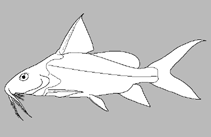
Body shape (shape guide): elongated.
This species is found in large numbers in a medium stream with large areas of exposed bedrock (Ref. 116018).
Lebenszyklus und Paarungsverhalten
Geschlechtsreife | Fortpflanzung | Ablaichen | Eier | Fruchtbarkeit | Larven
Schmidt, R.C., H.L. Bart, F. Pezold and J.P. Friel, 2017. A biodiversity hotspot heats up: Nine new species of suckermouth catfishes (Mochokidae: Chiloglanis) from Upper Guinean forest steams in West Africa. Copeia 105(2):301-338. (Ref. 116018)
IUCN Rote Liste Status (Ref. 130435: Version 2025-2 (Global))
Bedrohung für Menschen
Harmless
Nutzung durch Menschen
Fischereien: nicht kommerziell
Tools
Zusatzinformationen
Download XML
Internet Quellen
Schätzungen auf der Grundlage von Modellen
Phylogenetischer Diversitätsindex (Ref.
82804): PD
50 = 0.5000 [Uniqueness, from 0.5 = low to 2.0 = high].
Bayesian length-weight: a=0.00389 (0.00180 - 0.00842), b=3.12 (2.94 - 3.30), in cm total length, based on all LWR estimates for this body shape (Ref.
93245).
Trophische Ebene (Ref.
69278): 3.1 ±0.4 se; based on size and trophs of closest relatives
Widerstandsfähigkeit (Ref.
120179): hoch, Verdopplung der Population dauert weniger als 15 Monate. (Preliminary K or Fecundity.).
Anfälligkeit der Fischerei (Ref.
59153): Low vulnerability (10 of 100).
🛈