Classificazione / Nomi
Nomi Comuni | Sinonimi | Catalog of Fishes(Genere, Specie) | ITIS | CoL | WoRMS | Cloffa
>
Siluriformes (Catfishes) >
Mochokidae (Squeakers or upside-down catfishes) > Chiloglanidinae
Etymology: Chiloglanis: Greek, cheilos = lip + Greek, glanis = a fish that can eat the bait without touching the hook; a cat fish (Ref. 45335); kolente: The specific epithet refers to the Kolenté River where the species is endemic and is used as a noun in apposition (Ref. 116018).
Ambiente: milieu / zona climatica / distribuzione batimetrica / gamma di distribuzione
Ecologia
; acqua dolce benthopelagico. Tropical
Africa: Kolenté River in Guinea (Ref. 116018).
Dimensione / Peso / Età
Maturità: Lm ? range ? - ? cm
Max length : 2.6 cm SL maschio/sesso non determinato; (Ref. 116018)
Breve descrizione
Chiavi di identificazione | Morfologia | Morfometria
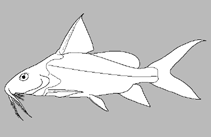
Spine dorsali (totale) : 2; Raggi dorsali molli (totale) : 4 - 5; Spine anali: 0; Raggi anali molli: 8 - 10. Diagnosis: Chiloglanis kolente is distinguished from C. waterloti and C. longibarbis in having more mandibular teeth in the functional row, and is distinguished from C. camarabounyi, C. dialloi, C. loffabrevum, C. tweddlei, C. lamottei, C. pezoldi, and C. polyodon in having fewer mandibular teeth in the functional row; it is easily distinguished from Chiloglanis aff. micropogon in having moderately long mandibular barbels vs. absent or reduced barbels; it is distinguished from C. normani in having males without sexually dimorphic caudal and anal fins; it is distinguished from C. occidentalis and C. nzerekore in having shorter dorsal and pectoral spines; it can be distinguished from C. kabaensis in having longer maxillary barbels, longer lateral mandibular barbels, and in attaining a smaller maximum standard length (Ref. 116018).
Body shape (shape guide): elongated.
Found in a small river with little flow (Ref. 116018).
Ciclo vitale e comportamento di accoppiamento
Maturità | Riproduzione | Deposizione | Uova | Fecondità | Larve
Schmidt, R.C., H.L. Bart, F. Pezold and J.P. Friel, 2017. A biodiversity hotspot heats up: Nine new species of suckermouth catfishes (Mochokidae: Chiloglanis) from Upper Guinean forest steams in West Africa. Copeia 105(2):301-338. (Ref. 116018)
Stato della Lista Rossa IUCN (Ref. 130435: Version 2025-2 (Global))
Minaccia per l'uomo
Harmless
Usi umani
Pesca: di nessun interesse
Strumenti
Rapporti speciali
Scarica XML
Fonti Internet
Stime basate su modelli
Indice di diversità filogenetica (Fonte Biblio.
82804): PD
50 = 0.5000 [Uniqueness, from 0.5 = low to 2.0 = high].
Bayesian length-weight: a=0.00389 (0.00180 - 0.00842), b=3.12 (2.94 - 3.30), in cm total length, based on all LWR estimates for this body shape (Ref.
93245).
Livello trofico (Fonte Biblio.
69278): 3.1 ±0.4 se; based on size and trophs of closest relatives
Resilienza (Fonte Biblio.
120179): Alto, tempo minimo di raddoppiamento della popolazione meno di 15 mesi (Preliminary K or Fecundity.).
Vulnerabilità della pesca (Ref.
59153): Low vulnerability (10 of 100).
🛈