Classificatie / Namen
Lokale namen | Synoniemen | Catalog of Fishes(Genus, Soort(en)) | ITIS | CoL | WoRMS | Cloffa
>
Siluriformes (Catfishes) >
Mochokidae (Squeakers or upside-down catfishes) > Chiloglanidinae
Etymology: Chiloglanis: Greek, cheilos = lip + Greek, glanis = a fish that can eat the bait without touching the hook; a cat fish (Ref. 45335); tweddlei: This species is named for Denis Tweddle, of the South African Institute for Aquatic Biodiversity (SAIAB), who collected most of the type material and provided the specimens; and he is recognized for his ongoing contributions to ichthyological research in Africa (Ref. 116018).
Eponymy: Denis (d: 1949) and Sharon Tweddle are husband and wife and together were honoured in the name of the dwarf sanjika for their contributions (e. [...] (Ref. 128868), visit book page.
Milieu: milieu / Klimaatzone / Diepte / verspreidingsgebied
Ecologie
; zoet water benthopelagisch. Tropical
Africa: St. John River drainage in Guinea and Liberia (Ref. 116018).
Grootte / Gewicht / Leeftijd
Maturiteit: Lm ? range ? - ? cm
Max length : 5.6 cm SL mannelijk / geslacht onbekend; (Ref. 116018)
Korte beschrijving
Determinatiesleutels | Morfologie | Morfometrie
Dorsale stekels (totaal) : 2; Dorsale zachte stralen (totaal) : 4 - 6; Anale stekels: 0; Anale zachte stralen: 9 - 10. Diagnosis: Chiloglanis tweddlei is distinguished from C. waterloti, C. normani, C. occidentalis, C. nzerekore, C. longibarbis, C. kabaensis, and C. kolente in having more mandibular teeth in the functional row; it can be easily distinguished from C. polyodon and C. lamottei in having fewer mandibular teeth in the functional row, and from Chiloglanis aff. micropogon in having moderately long medial and lateral mandibular barbels vs. absent or reduced barbels; it is distinguished from C. dialloi, C. loffabrevum, and C. camarabounyi in having longer dorsal and pectoral spines; it can be distinguished from C. pezoldi in having a wider premaxillary tooth patch, 15.3-18.2% of standard length vs. 12.2-15.8%, and in having more premaxillary teeth in four rows vs. fewer teeth in three rows (Ref. 116018).
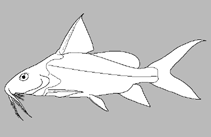
Body shape (shape guide): elongated.
This species was collected in a medium-sized stream (3-12m) with mostly sand and bedrock ridges, as well as, fallen trees and undercut tree roots (Ref. 116018).
Levenscyclus en paargedrag
Maturiteit | Voortplanting | Paaien | Eieren | Fecunditeit | Larven
Schmidt, R.C., H.L. Bart, F. Pezold and J.P. Friel, 2017. A biodiversity hotspot heats up: Nine new species of suckermouth catfishes (Mochokidae: Chiloglanis) from Upper Guinean forest steams in West Africa. Copeia 105(2):301-338. (Ref. 116018)
Status op de Rode Lijst van het IUCN (Ref. 130435: Version 2025-2 (Global))
Gevaar voor de mens
Harmless
Gebruik door de mens
Visserij: van geen belang
Tools
Speciale rapporten
Download XML
Internetbronnen
Schattingen op basis van modellen
Fylogenetische diversiteitsindex (Ref.
82804): PD
50 = 0.5000 [Uniqueness, from 0.5 = low to 2.0 = high].
Bayesian length-weight: a=0.00389 (0.00180 - 0.00842), b=3.12 (2.94 - 3.30), in cm total length, based on all LWR estimates for this body shape (Ref.
93245).
Trofisch niveau (Ref.
69278): 3.2 ±0.4 se; based on size and trophs of closest relatives
Weerstandsvermogen (Ref.
120179): Hoog, minimale populatieverdubbelingstijd minder dan 15 maanden (Preliminary K or Fecundity.).
Kwetsbaarheid van de visserij (Ref.
59153): Low vulnerability (10 of 100).
🛈