Klassifizierung / Names
Namen | Synonyme | Catalog of Fishes(Gattung, Arten) | ITIS | CoL | WoRMS | Cloffa
>
Cichliformes (Cichlids, convict blennies) >
Cichlidae (Cichlids) > Pseudocrenilabrinae
Etymology: Astatotilapia: Greek, astato = unstable + Bechuana, African native thiape = fish (Ref. 45335).
Umwelt: Milieu / Klimazone / Tiefenbereich / Verbreitungsgebiet
Ökologie
; süßwasser pelagisch. Tropical
Africa: Lake Boukou, Ounianga Serir, in Chad (Ref. 112399). Also Lake Chad and its basin in Chad, Cameroon, Nigeria, Niger and Central African Republic (Ref. 112399).
Größe / Gewicht / Alter
Geschlechtsreife: Lm ? range ? - ? cm
Max length : 9.8 cm SL Männchen/unbestimmt; (Ref. 112399)
Kurzbeschreibung
Bestimmungsschlüssel | Morphologie | Morphometrie
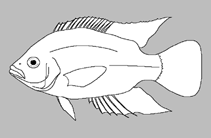
Rückenflossenstacheln (insgesamt) : 13 - 14; Rückenflossenweichstrahlen (insgesamt) : 9 - 11; Afterflossenstacheln: 3; Afterflossenweichstrahlen: 8 - 9. Diagnosis: A large haplochromine cichlid fish characterized by the following combination of characters: a black bar between the eye and the corner of mouth, rounded orange spots on the anal fin in adult males, scales ctenoid, outer jaw teeth bicuspid, inner teeth tricuspid, 16 scales around the peduncle, no papillose swelling on either side of pharynx, lower limb of first gill arch with 7-8 gill rakers, dorsal fin with 13-14 spines and 9-11 soft rays, anal fin with 3 spines and 8-9 soft rays, 29 or 30 lateral line scales, lower pharyngeal dentition with enlarged molariform teeth in the central rows (Ref. 112399).
Body shape (shape guide): fusiform / normal.
Found in Lake Boukou with emergent aquatic vegetation, mainly Cyperus laevigatus, Typha australis and Phragmites australis, covering approximately the two-thirds of the lake's surface; submerged macrophyte beds include Potamogeton (Ref. 112399).
Lebenszyklus und Paarungsverhalten
Geschlechtsreife | Fortpflanzung | Ablaichen | Eier | Fruchtbarkeit | Larven
Trape, S., 2016. A new cichlid fish in the Sahara: the Ounianga Serir lakes (Chad), a biodiversity hotspot in the desert. C. R. Biol. 339:529-536. (Ref. 112399)
IUCN Rote Liste Status (Ref. 130435: Version 2025-2 (Global))
Bedrohung für Menschen
Harmless
Nutzung durch Menschen
Tools
Zusatzinformationen
Download XML
Internet Quellen
Schätzungen auf der Grundlage von Modellen
Phylogenetischer Diversitätsindex (Ref.
82804): PD
50 = 0.5020 [Uniqueness, from 0.5 = low to 2.0 = high].
Bayesian length-weight: a=0.01445 (0.00671 - 0.03113), b=2.99 (2.82 - 3.16), in cm total length, based on LWR estimates for this (Sub)family-body shape (Ref.
93245).
Trophische Ebene (Ref.
69278): 3.0 ±0.3 se; based on size and trophs of closest relatives
Widerstandsfähigkeit (Ref.
120179): hoch, Verdopplung der Population dauert weniger als 15 Monate. (Preliminary K or Fecundity.).
Anfälligkeit der Fischerei (Ref.
59153): Low vulnerability (10 of 100).
🛈