Classification / Noms
Noms communs | Synonymes | Catalog of Fishes(Genre, Espèce) | ITIS | CoL | WoRMS | Cloffa
>
Gobiiformes (Gobies) >
Gobiidae (Gobies) > Gobionellinae
Etymology: Schismatogobius: Greek, schisma, -atos = crack, fissure + latin, gobius = gudgeon (Ref. 45335); saurii: Named for Sopian Sauri from LIPI, who helped the authors to collect freshwater fishes all around Indonesia.
Eponymy: Sopian Sauri is an Indonesian zoologist and ichthyologist who works at LIPI (Indonesian Institute of Sciences), Zoology Division, Museum Zoologicum Bogoriense, Djakarta. [...] (Ref. 128868), visit book page.
Environnement : milieu / zone climatique / profondeur / gamme de distribution
Écologie
; eau douce démersal; profondeur 0 - 1 m (Ref. 123786). Tropical
Asia: Indonesia, the Philippines and Japan.
Taille / Poids / Âge
Maturité: Lm ? range ? - ? cm
Max length : 3.7 cm SL mâle / non sexé; (Ref. 116448); 4.0 cm SL (female)
Description synthétique
Clés d'identification | Morphologie | Morphométrie
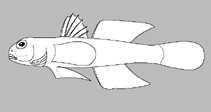
Épines dorsales (Total) : 7; Rayons mous dorsaux (Total) : 9; Épines anales: 1; Rayons mous anaux: 9. Schismatogobius saurii can be distinguished by the following characters: pectoral fin with 14-15 rays; pectoral fins banded with rows of dark spots; first dorsal fin membrane posterior to spine 6
connected to base of spine of second dorsal fin; Anal fin with 1 spine and 9 rays; and ventral surface of head in male whitish and slightly pigmented on the mentum and frenum or entirely brownish (vs. ventral surface of head in female whitish with a blackish or brownish mentum (Ref. 116448).
Body shape (shape guide): elongated.
Recorded from Indonesia in streams with moderate to fast flow in shallow areas of gravel and boulders at depth of 0.4-0.6 m, usually at low altitude (< 10 m), and sometimes with Schismatogobius bruynisi (Ref. 116448). On the other hand, specimens from Japan (as Schismatogobius ninja) were collected from the lower freshwater reaches of the streams, at 50 to 1,300 m from the upper limit of tidal fluctuations; on coarse sand and gravel bottoms of shallow areas (depth usually 5-30 cm) around rapids, a typical habitat was at the ends of the rapids (transitional areas from rapid to pool) with steady flow. This species usually stay on the bottom and often bury half of their body in the substratum, preferring substrates with free gravel granules which can be moved easily by water flow, and do not inhabit silty substrates. Body markings perfectly camouflage them on the gravel bottom of their habitats; thus, are hard to detect if they remain motionless. Occurs with S. ampluvinculus, and sometimes with Schismatogobius marmoratus, but the most abundant syntopic species was Rhinogobius nagoyae; other gobies, such as Stiphodon percnopterygionus, Sicyopterus lagocephalus, Glossogobius illimis and Luciogobius ryukyuensis and amphidromous pipefish, Microphis leiaspis, were also frequently observed with this species (Ref. 125666).
Cycle de vie et comportement reproducteur
Maturité | Reproduction | Frai | Œufs | Fécondité | Larves
Keith, P., C. Lord, H. Darhuddin, G. Limmon, T. Sukmono, R. Hadiaty and N. Hubert, 2017. Schismatogobius (Gobiidae) from Indonesia, with description of four new species. Cybium 41(2):195-211. (Ref. 116448)
Statut dans la liste rouge de l'IUCN (Ref. 130435: Version 2025-2 (Global))
Menace pour l'homme
Harmless
Utilisations par l'homme
Outils
Articles particuliers
Télécharger en XML
Sources Internet
Estimations basées sur des modèles
Indice de diversité phylogénétique (Réf.
82804): PD
50 = 0.5000 [Uniqueness, from 0.5 = low to 2.0 = high].
Bayesian length-weight: a=0.00708 (0.00332 - 0.01511), b=3.07 (2.89 - 3.25), in cm total length, based on LWR estimates for this (Sub)family-body shape (Ref.
93245).
Niveau trophique (Réf.
69278): 3.2 ±0.5 se; based on size and trophs of closest relatives
Résilience (Réf.
120179): Haut, temps minimum de doublement de population inférieur à 15 mois (Preliminary K or Fecundity.).
Vulnérabilité de la pêche (Ref.
59153): Low vulnerability (10 of 100).
🛈