Classificação / Nomes
Nomes comuns | Sinônimos | Catalog of Fishes(Gênero, Espécies) | ITIS | CoL | WoRMS | Cloffa
>
Cyprinodontiformes (Rivulines, killifishes and live bearers) >
Nothobranchiidae (African rivulines)
Etymology: Aphyosemion: Greek, aphye, -es, sardine, anchovy + Greek, semeion = mark, signal (Ref. 45335); jeanhuberi: Named in honour of Dr. Jean Henri Huber (Paris), who discovered this species, and also in appreciation of his long-term as well as inestimable contribution to the knowledge of oviparous Cyprinodontiformes (Ref. 116455).
Eponymy: Dr Jean-Henri Huber (b: 1952) is a French ichthyologist with a particular interest in killifish. He discovered this species. (See Huber, JH) (Ref. 128868), visit book page.
Meio ambiente: milieu / Zona climática / intervalo de profundidade / faixa de distribuição
Ecologia
; Água doce pelágico(a,os,as). Tropical
Africa: upper Ngounié River, tributary of Ogooué River, and Bibaka River, tributary of Nyanga River, on the southwestern part of the Massif du Chaillu in southern Gabon and southwestern Republic of Congo (Ref. 116455).
Tamanho / Peso / Idade
Maturidade: Lm ? range ? - ? cm
Max length : 3.9 cm SL macho/indeterminado; (Ref. 116455)
Descrição suscinta
Chaves de identificação | Morfologia | Morfometria
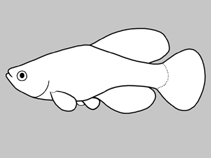
Espinhos dorsais (total) : 0; Raios dorsais (total) : 13 - 14; Espinhos anais: 0; Raios anais : 15 - 16. Diagnosis: Aphyosemion jeanhuberi belongs to the Aphyosemion ogoense species group, which are characterized by presenting dark red margin on dorsal fin and dorsal portion of caudal fin, an asymmetric caudal fin shape, and wide dark red stripes parallel to the caudal fin rays in males (Ref. 116455). Males of A. jeanhuberi can be distinguished from males of the remaining species belonging to this assemblage by theit unique colouration consisting of isolated red dots on the flanks and caudal peduncle over a light blue background, vs. two horizontal red stripes in Aphyosemion ogoense, a wide red middorsal stripe in Aphyosemion louessense, vertical, irregular red bars in Aphyosemion pyrophore, a wide vertical red bar on the central portion of the caudal fin in Aphyosemion caudofasciatum, and horizontal lines in Aphyosemion ottogartneri (Ref. 116455).
Body shape (shape guide): fusiform / normal.
Found in small and shallow permanent forest streams (Ref. 116455).
Ciclo de vida ou comportamento de acasalamento
Maturidade | Reprodução | Desova | Ovos | Fecundidade | Larvas
Valdesalici, S. and W. Eberl, 2015. Aphyosemion jeanhuberi, a new killifish species of the Aphyosemion ogoense species group (Cyprinodontiformes: Nothobranchiidae), with remarks on the identity of Aphyosemion louessense (Pellegrin, 1931). aqua, Int. J. Ichthyol. 21(3):110-119. (Ref. 116455)
Status na Lista Vermelha da UICN (Ref. 130435: Version 2025-2 (Global))
Ameaça para os humanos
Harmless
Uso pelos humanos
Ferramentas
Relatórios especiais
Baixar XML
Fontes da internet
Estimativas baseadas em modelos
Índice de diversidade filogenética (Ref.
82804): PD
50 = 0.5000 [Uniqueness, from 0.5 = low to 2.0 = high].
Bayesian length-weight: a=0.00603 (0.00250 - 0.01453), b=3.13 (2.93 - 3.33), in cm total length, based on LWR estimates for this (Sub)family-body shape (Ref.
93245).
Nível Trófico (Ref.
69278): 3.2 ±0.5 se; based on size and trophs of closest relatives
Vulnerabilidade da pesca (Ref.
59153): Low vulnerability (10 of 100).
🛈