Classificazione / Nomi
Nomi Comuni | Sinonimi | Catalog of Fishes(Genere, Specie) | ITIS | CoL | WoRMS | Cloffa
>
Siluriformes (Catfishes) >
Astroblepidae (Naked sucker-mouth catfishes)
Etymology: Astroblepus: Greek, astra = ray + Greek, blepo = to look (Ref. 45335).
Eponymy: Dr Hernán Ortega Torres is a Peruvian ichthyologist at the National University of San Marcos, Lima, where he is Professor and Curator of the fish collection in the university’s Museum of Natural History. [...] (Ref. 128868), visit book page.
Ambiente: milieu / zona climatica / distribuzione batimetrica / gamma di distribuzione
Ecologia
; acqua dolce demersale. High altitude
South America: Andes, Peru.
Dimensione / Peso / Età
Maturità: Lm ? range ? - ? cm
Max length : 9.3 cm SL maschio/sesso non determinato; (Ref. 93748)
Breve descrizione
Chiavi di identificazione | Morfologia | Morfometria
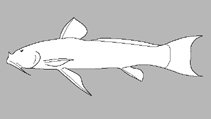
Astroblepus ortegai can be diagnosed from all congeners by its adipose fin which is a membrane without spine and by having the following characters: maxillary wattle doesn't reach beyond the oral disk; first pectoral radius is shorter than head longitude and has 9 soft branching radii, 6 of them associated to the third radial; first radius of pelvic fin doesn't go beyond the anus; pre-maxillary with two internal rows of bicuspid teeth, the outermost row has 13 tricuspid teeth; first simple radii of caudal fin without extension; 24 free vertebrae, and fifth cerato-branchial bone having 17 teeth in the anterior region (Ref. 93748).
Body shape (shape guide): elongated.
Ciclo vitale e comportamento di accoppiamento
Maturità | Riproduzione | Deposizione | Uova | Fecondità | Larve
Ardila Rodriguez, C.A., 2012. Astroblepus ortegai y Astroblepus quispei. Dos nuevas especies des los Andes del Perú. Universidad Metropolitana, Departmento del Atlántico. Barranquilla. 16 pp. (Ref. 93748)
Stato della Lista Rossa IUCN (Ref. 130435: Version 2025-2 (Global))
Minaccia per l'uomo
Harmless
Usi umani
Strumenti
Rapporti speciali
Scarica XML
Fonti Internet
Stime basate su modelli
Indice di diversità filogenetica (Fonte Biblio.
82804): PD
50 = 0.5000 [Uniqueness, from 0.5 = low to 2.0 = high].
Bayesian length-weight: a=0.01023 (0.00432 - 0.02423), b=3.03 (2.84 - 3.22), in cm total length, based on LWR estimates for this Genus-body shape (Ref.
93245).
Livello trofico (Fonte Biblio.
69278): 3.3 ±0.5 se; based on size and trophs of closest relatives
Vulnerabilità della pesca (Ref.
59153): Low vulnerability (10 of 100).
🛈