Classification / Noms
Noms communs | Synonymes | Catalog of Fishes(Genre, Espèce) | ITIS | CoL | WoRMS | Cloffa
>
Pleuronectiformes (Flatfishes) >
Soleidae (Soles)
Etymology: Aseraggodes: Greek, aggos, -eos, -ous = vessel, uterus, carapace of a crab + Greek, aseros, -a, -on = to remove the appetite (Ref. 45335); martine: Named for Martine Dessouter-Meniger in recognition of her research on soleid fishes; noun in apposition.
Environnement : milieu / zone climatique / profondeur / gamme de distribution
Écologie
marin récifal; profondeur ? - 2 m (Ref. 95111). Tropical
Western Indian Ocean: India and Seychelles.
Taille / Poids / Âge
Maturité: Lm ? range ? - ? cm
Max length : 6.5 cm SL (female)
Description synthétique
Clés d'identification | Morphologie | Morphométrie
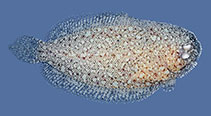
Épines dorsales (Total) : 0; Rayons mous dorsaux (Total) : 65 - 67; Épines anales: 0; Rayons mous anaux: 42 - 43; Vertèbres: 33 - 34. This species is distinguished by the following characters: D 65-67; A 42-43; all fin rays branched, except first 14 of dorsal fin, first of anal fin, and lateral 2 of caudal fin; lateral-line scales 66-69; vertebrae 33 or 34; dorsal pterygiophores anterior to fourth neural spine 15 or 16; body depth 2.5 (2.35) in SL; head length 4.35 in SL; caudal peduncle short, 9-14 in head length; snout length 2.75 in head length; tubular anterior nostril conical, as long as diameter of upper eye; origin of dorsal fin at base of upper lip; in alcohol, colour of ocular side yellowish white with a faint longitudinal orangish band below the base of dorsal and anal fins; an indistinct dusky spot about twice eye diameter on lateral line about two head lengths posterior to head; scattered small blackish flecks, most from dark outer edges of scales; when fresh, colour of ocular side light yellowish brown, with scale edges darker brown, except within numerous dark-edged, pale spots that vary from nearly round to irregularly ovate, none larger than eye; fin membranes mainly transparent, the rays blotched and spotted with greenish yellow, especially basally; front of head translucent; lappet-like cirri anteriorly and ventrally on margin of head whiter (Ref. 95111).
Body shape (shape guide): short and / or deep; Cross section: flattened.
Cycle de vie et comportement reproducteur
Maturité | Reproduction | Frai | Œufs | Fécondité | Larves
Randall, J.E., S.V. Bogorodsky and O. Mal, 2013. Four new soles (Pleuronectiformes: Soleidae) of the genus Aseraggodes from the western Indian Ocean. J. Ocean Sci. Found. 8:1-17. (Ref. 95111)
Statut dans la liste rouge de l'IUCN (Ref. 130435: Version 2025-2 (Global))
Menace pour l'homme
Harmless
Utilisations par l'homme
Outils
Articles particuliers
Télécharger en XML
Sources Internet
Estimations basées sur des modèles
Indice de diversité phylogénétique (Réf.
82804): PD
50 = 0.5000 [Uniqueness, from 0.5 = low to 2.0 = high].
Bayesian length-weight: a=0.00955 (0.00454 - 0.02011), b=3.07 (2.90 - 3.24), in cm total length, based on LWR estimates for this (Sub)family-body shape (Ref.
93245).
Niveau trophique (Réf.
69278): 3.4 ±0.5 se; based on size and trophs of closest relatives
Résilience (Réf.
120179): Haut, temps minimum de doublement de population inférieur à 15 mois (Preliminary K or Fecundity.).
Vulnérabilité de la pêche (Ref.
59153): Low vulnerability (10 of 100).
🛈