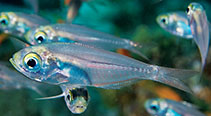
Klassifizierung / Names
Namen | Synonyme | Catalog of Fishes(Gattung, Arten) | ITIS | CoL | WoRMS | Cloffa
>
Acropomatiformes (Oceanic basses) >
Pempheridae (Sweepers)
Etymology: Parapriacanthus: Greek, para = near + Greek, prion = saw + Greek, akantha = thorn (Ref. 45335); sharm: Named for its type locality, the Egyptian dive-resort city of Sharm el Sheikh near the southern end of the Sinai Peninsula, and the gateway to Ras Muhammed National Park. Sharm in Arabic
means narrow passage; the city contains a narrow isthmus between the Gulf of Aqaba and the Gulf of Suez; noun in apposition.
Umwelt: Milieu / Klimazone / Tiefenbereich / Verbreitungsgebiet
Ökologie
seewasser riff-verbunden. Tropical
Western Indian Ocean: Red Sea, Gulf of Aqaba (Egypt).
Größe / Gewicht / Alter
Geschlechtsreife: Lm ? range ? - ? cm
Max length : 6.2 cm SL (female)
Kurzbeschreibung
Bestimmungsschlüssel | Morphologie | Morphometrie
Rückenflossenstacheln (insgesamt) : 6; Rückenflossenweichstrahlen (insgesamt) : 9; Afterflossenstacheln: 3; Afterflossenweichstrahlen: 22 - 23. This species is characterized by the following: D VI,9; A III,22 (22-23); pectoral-fin rays 17 (16-17, modally 17); lateral-line scales 67 (64-68); scale rows above lateral line to base of dorsal fin 5.5; gill rakers 25 (25-26); body depth 3.1 (3.1-3.15) in SL, width 2.35 (2.2-2.35) in body depth; depth of caudal-peduncle 10.1 (9.5-10.2) in SL; head length 2.85 (2.75-2.8) in SL; snout length 13.2 (12.0-13.0) in SL; relatively large eye, orbit diameter 6.9 (6.7-6.8) in SL with interorbital width 12.2 (11.7-12.1); mouth forming an angle of about 65° to horizontal axis of body; mouth when fully close has the lower jaw slightly protruding; upper jaw with 2 irregular rows of slender, recurved teeth with those of the upper row initially in the same plane as the surface of upper lip, then sharply curved inwardly and posteriorly, while the inner row of teeth are more sharply recurved, teeth continue in two rows. progressively smaller, nearly to end of jaw, before reduced to a single row; lower jaw with a row of slightly smaller, strongly recurved slender teeth; vomer with small, incurved, sharply conical teeth in a single irregular V-shaped row, similar in a row on palatines; thin lips, with very small, well-spaced, dark purple papillae; tongue broadly triangular, indented slightly on sides anteriorly to form a small, rounded, thickened tip; predorsal length 2.45 (2.4-2.45) in SL; first dorsal-fin soft ray longest, 4.7 (broken & 4.8) in SL; caudal-fin forked, fin length 4.35 (4.05-4.1) in SL; pectoral-fin length 3.4 (3.1-3.15) in SL; prepelvic length 2.6 (2.55-2.7) in SL; pelvic fins far from anus, the fin length 5.0 (5.35-5.7) in SL; preanal length 1.55 (1.5-1.6) in SL; without a pin-like dark line anterior to anus; black iris in preserved holotype (Ref. 107896).
Body shape (shape guide): short and / or deep; Cross section: compressed.
Lebenszyklus und Paarungsverhalten
Geschlechtsreife | Fortpflanzung | Ablaichen | Eier | Fruchtbarkeit | Larven
Randall, J.E. and S.V. Bogorodsky, 2016. Preliminary review of the pempherid fish genus Parapriacanthus of the western Indian Ocean, with descriptions of five new species. J. Ocean Sci. Found. 20:1-24. (Ref. 107896)
IUCN Rote Liste Status (Ref. 130435: Version 2025-2 (Global))
Bedrohung für Menschen
Harmless
Nutzung durch Menschen
Fischereien: kleinfischerei
Tools
Zusatzinformationen
Download XML
Internet Quellen
Schätzungen auf der Grundlage von Modellen
Phylogenetischer Diversitätsindex (Ref.
82804): PD
50 = 0.5005 [Uniqueness, from 0.5 = low to 2.0 = high].
Bayesian length-weight: a=0.01479 (0.00642 - 0.03409), b=3.00 (2.80 - 3.20), in cm total length, based on LWR estimates for this (Sub)family-body shape (Ref.
93245).
Trophische Ebene (Ref.
69278): 3.3 ±0.4 se; based on size and trophs of closest relatives
Widerstandsfähigkeit (Ref.
120179): hoch, Verdopplung der Population dauert weniger als 15 Monate. (Preliminary K or Fecundity.).
Anfälligkeit der Fischerei (Ref.
59153): Low vulnerability (10 of 100).
🛈