การจำแนกประเภท / ชื่อ
ชื่อสามัญ | ชื่อพ้อง | Catalog of Fishes(สกุล, ชนิด) | ITIS | CoL | WoRMS | Cloffa
>
Gobiiformes (Gobies) >
Gobiidae (Gobies) > Gobiinae
Etymology: Tomiyamichthys: occurring on sand-rubble bottoms in the vicinity of coral reefs; levisquama: Name from Greek 'levis' for smooth and 'squama' for scale, referring to the cycloid scales; noun
in apposition.
สิ่งแวดล้อม : สิ่งแวดล้อม / เขตภูมิอากาศ / ระดับความลึก / ระยะการกระจายสินค้า
นิเวศวิทยา
เกี่ยวกับทะเล,น้ำเค็ม สัตว์น้ำหน้าดิน; ระดับความลึก 0 - 25 m (Ref. 116701). Tropical
การแพร่กระจาย
อาณาเขต | พื้นที่จำแนกตาม FAO | ระบบนิเวศหลายระบบ | การปรากฏขึ้น,การเกิดขึ้น,พบ | ตำแหน่งบนแผนที่ | การแนะนำ | Faunafri
Western Pacific: Australia.
ขนาด / น้ำหนัก / อายุ
วัยเจริญพันธุ์: Lm ? range ? - ? cm
Max length : 6.9 cm SL เพศผู้/กระเทย; (Ref. 116701); 6.9 cm SL (female)
คำอธิบายสั้นๆ
เครื่องมือที่ใช้ในการแยกชนิดสัตว์,สิ่งมีชีวิตออกจากกัน | สัณฐานวิทยา | ความยาวต่างๆ
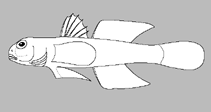
เงี่ยงครีบหลัง (รวม) : 7; ก้านครีบอ่อนที่หาง (รวม) : 10 - 11; เงี่ยงครีบก้น: 1; ก้านครีบอ่อนที่ก้น: 10 - 11. This species is distinguished by the following characters: mental fraenum is truncate, with straight posterior margin; large mouth reaching to point below posterior quarter of eye; jaws forming an angle of 35-45° with body axis; upper margin of the upper jaw is in line with point just below eye; with a distinct groove behind eye formed by elevated eyes and triangular projection of skin from nape; slightly bulbous cheeks. very narrow interorbital with less than pupil diameter; gill opening reaching to below a point just behind posterior preopercular margin; head papillae in longitudinal pattern; entirely cycloid scales; predorsal area is partly scaled, midline naked, or rarely with one scale before first dorsal fin, sides of nape scaled forward in an arch from first dorsal origin to above middle to anterior part of operculum; naked cheek, operculum and pectoral fin base; scaled prepelvic area, except for small area anteriorly, scales embedded and not easily seen; belly is covered with cycloid scales, except for a small naked area just behind pelvic fin insertion; first dorsal fin low, with rounded to slightly pointed margin, the 3rd to 5th spines longest and not filamentous, spines 3-5 extending beyond other spines when fin depressed; first dorsal fin sometimes with a small black spot on membranes between distal tips of third and fourth spines; pelvic disc with a median dark stripe; body possess 3 slightly oblique dark bands and rounded spot at end of caudal peduncle extending onto caudal fin; D2 I,10; A I,10; pectoral fin rays often 18-19; longitudinal scale count 50-70; predorsal scale count 0-4; transverse scale count (TRB) 23-25 (Ref. 116701).
Body shape (shape guide): elongated; Cross section: oval.
Occurs over mud bottom (Ref. 116701).
วงจรชีวิตและพฤติกรรมการผสมพันธุ์
วัยเจริญพันธุ์ | การสืบพันธุ์ | การวางไข่ | เซลสืบพันธ์ของเพศเมีย(ไข่) | ความดกของไข่ | ตัวอ่อน
Hoese, D. F., Shibukawa, K. and J.W. Johnson, 2016. Description of a new species of Tomiyamichthys from Australia with a discussion of the generic name. Zootaxa 4079(5):582-594. (Ref. 116701)
สถานะบัญชีแดงของ IUCN (Ref. 130435: Version 2025-2 (Global))
ภัยคุกคามต่อมนุษย์
Harmless
การใช้ของมนุษย์
การประมง: bycatch
เครื่องมือ
รายงานพิเศษ
ดาวน์โหลด XML
แหล่งที่มาจากอินเตอร์เน็ต
การประมาณค่าตามแบบจำลอง
ดัชนีความหลากหลายทางวิวัฒนาการ (อ้างอิง
82804): PD
50 = 0.5000 [Uniqueness, from 0.5 = low to 2.0 = high].
Bayesian length-weight: a=0.00741 (0.00347 - 0.01582), b=3.09 (2.91 - 3.27), in cm total length, based on LWR estimates for this (Sub)family-body shape (Ref.
93245).
ระดับชั้นอาหาร (อ้างอิง
69278): 3.3 ±0.3 se; based on size and trophs of closest relatives
ความสามารถในการกลับคืนสู่ปกติ (อ้างอิง
120179): ความสูง, เวลาต่ำสุดที่จะทำให้ประชากรเพิ่มขึ้นเป็น 2 เท่าใช้เวลาน้อยกว่า 15 เดือน (Preliminary K or Fecundity.).
ความเสี่ยงต่อการตกปลา (Ref.
59153): Low vulnerability (10 of 100).
🛈