Clasificación / Nombres
Nombres comunes | Sinónimos | Catalog of Fishes(Género, Especie) | ITIS | CoL | WoRMS | Cloffa
>
Cypriniformes (Carps) >
Nemacheilidae (Brook loaches)
Etymology: Malihkaia: Named for its type locality, Mali Hka River; aligera: Named from Latin adjective aliger (aligera, aligerum), meaning winged.
Entorno: milieu / zona climática / rango de profundidad / gama de distribución
Ecología
; agua dulce demersal. Tropical
Asia: Mali Hka River near Putao, Myanmar.
Tamaño / Peso / Edad
Madurez: Lm ? range ? - ? cm
Max length : 7.7 cm SL macho / no sexado; (Ref. 116725)
Descripción breve
Claves de identificación | Morfología | Morfometría
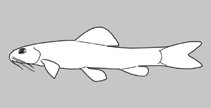
Radios blandos dorsales (total) : 12; Radios blandos anales: 8. Malihkaia is diagnosed from all genera of nemacheilids by the unique morphology of the lips and the unique pectoral fin sexual dimorphism. Lips are characterized by the following traits: : thick, consting of numerous, closely set, deep furrows; upper lip with a small median notch, transverse furrows on its whole length, edge crenulated; lower lip with a median interruption, transverse furrows on its whole length, edge crenulated. Pectoral fin is strongly falcate in males, greatly elongated as a ‘wing’, rigid and curled, with the first branched ray the longest, and with all branches and sub-branches adjacent and absence of membranes between them. Other diagnostic characters include the following: presence of processus dentiformis; presence of suborbital flap present in males; dorsal fin with 8½ branched rays; caudal fin with 9+8 branched rays; presence of axillary pelvic lobe; anus situated about 1.5-2 eye diameter in front of anal fin; body entirely scaled; lateral line complete; air bladder without posterior chamber; body with 9-12 bars extending from dorsal midline to level of pectoral fin, bars of quite regular width and shape in front of dorsal fin, less regular posteriorly, much wider than interspaces; and black mark at caudal-fin base made of a more or less squarish blotch in middle of base, a more or less triangular blotch over dorsal procurrent rays, fainter pigments over base of uppermost and lowermost 4-6 principal rays of caudal fin (Ref. 116725).
Found in fast riffles over gravel and cobble at about 60 cm depth. Syntopic with Bangana sp., Garra sp. (Cyprinidae), Psilorhynchus brachyrhynchus (Psilorhynchidae), Homalopteroides rupicola (Balitoridae), Acanthocobitis sp., Schistura malaisei, S. nubigena, S. sikmaiensis (Nemacheilidae), Batasio procerus (Bagridae), Amblyceps murraystuarti (Amblycipitidae), Pseudecheneis brachyurus (Sisoridae) and Mastacembelus armatus (Mastacembelidae). Stomach contents contained insects (Ref. 116725).
Ciclo vital y comportamiento de apareamiento
Madurez | Reproducción | Puesta | Huevos | Fecundidad | Larva
Kottelat, M., 2017. A new genus and three new species of nemacheilid loaches from northern Irrawaddy drainage, Myanmar (Teleostei: Cypriniformes). Raffles Bull. Zool. 65:80-99. (Ref. 116725)
Situación en la Lista Roja de la UICN (Ref. 130435: Version 2025-2 (Global))
Amenaza para el ser humano
Harmless
Usos humanos
Herramientas
Informes especiales
Descargar XML
Fuentes de Internet
Estimaciones basadas en modelos
Índice de diversidad filogenética (Referencia
82804): PD
50 = 1.0000 [Uniqueness, from 0.5 = low to 2.0 = high].
Bayesian length-weight: a=0.00724 (0.00352 - 0.01491), b=3.01 (2.84 - 3.18), in cm total length, based on LWR estimates for this (Sub)family-body shape (Ref.
93245).
Nivel trófico (Referencia
69278): 2.8 ±0.3 se; based on size and trophs of closest relatives
Resiliencia (Referencia
120179): Medio, población duplicada en un tiempo mínimo de 1.4-4.4 años (Preliminary K or Fecundity.).
Vulnerabilidad pesquera (Ref.
59153): Low vulnerability (10 of 100).
🛈