Klassificering / Namn
Populärnamn | synonymer | Catalog of Fishes(Släkte, Arter) | ITIS | CoL | WoRMS | Cloffa
>
Cypriniformes (Carps) >
Leuciscidae (Minnows) > Leuciscinae
Etymology: Alburnoides: From the city of Al Bura, where the fish was known + particle Greek, oides = similar (Ref. 45335).
Miljö: miljö / Klimatzon / djupintervall / distributionsområde
Ekologi
; sötvatten bentopelagisk. Subtropical
Europe: Pinios and Aliakmon River drainages in Greece. It is presumed that specimens of the transboundary Axios/Vardar basin in both Greece and the Former Yugoslav Republic of Macedonia also belong to Alburnoides thessalicus.
Storlek / Vikt / Ålder
Könsmognad: Lm ? range ? - ? cm
Max length : 8.1 cm SL hane/ej könsbestämd; (Ref. 116746); 9.1 cm SL (female)
Kort beskrivning
Bestämningsnycklar | Morfologi | Morfometri
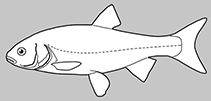
Mjukstrålar i ryggfenan (totalt) : 10 - 12; Mjukstrålar i analfenan: 14 - 17. Alburnoides thessalicus is distinguished from other species by the following combination of characters: body deep and relatively thick; snout stout, slightly to clearly rounded; snout length about equivalent to the eye diameter; mouth oblique, almost terminal, uppermost point of cleft below level of the middle of the eye to below the of lower margin of pupil; mouth cleft in lateral view
slightly slanted in its posterior part; sharp ventral keel in 2/3 of its length, variably scaled with modally 4?6 scales; anal fin usually with 12 1/2 branched rays; lateral line with 44?50 + 0?2 pored scales; usually 9?10 scales between lateral line and dorsal fin origin and 4 scales between lateral line and midline of the belly; 24?28 pre-dorsal scales; caudal fin clearly forked with lobes moderately pointed (Ref. 116746).
Body shape (shape guide): fusiform / normal.
Occurs in variety of streams and rivers with fast-flowing waters and cobble-pebble substrate. Usually found in upland areas in cool waters. Spawns during middle spring in Pinios River. Often collected with the following species: Squalius vardarensis, B. sperchiensis, B. balcanicus Kotlík, Tsigenopoulos, Ráb & Berrebi, 2002, Chondrostoma vardarense Karaman, 1928, Gobio bulgaricus Drensky, 1926 and Sabanejewia balcanica (Karaman, 1922) (Ref. 116746).
Livscykel och parningsbeteende
Könsmognad | Reproduktion | Lek | Ägg | Fekunditet | Larver
Barbieri, R., J. Vukić, R. Šanda, Y. Kapakos and S. Zogaris, 2017. Alburnoides economoui, a new species of spirlin from Central Greece and redescription of Alburnoides thessalicus (Actinopterygii: Cyprinidae). Biologia 71(9):1075-1088. (Ref. 116746)
Status på IUCN:s rödlista (Ref. 130435: Version 2025-2 (Global))
Hot mot människor
Harmless
Mänskliga användningsområden
Fiskeri: saknar intresse
Verktyg
Särskilda rapporter
Ladda ner XML
Internet-källor
Uppskattningar baserade på modeller
Index för fylogenetisk mångfald (Ref.
82804): PD
50 = 0.5000 [Uniqueness, from 0.5 = low to 2.0 = high].
Bayesian length-weight: a=0.00741 (0.00335 - 0.01640), b=3.14 (2.97 - 3.31), in cm total length, based on LWR estimates for this Genus-body shape (Ref.
93245).
Trofisk nivå (Ref.
69278): 3.1 ±0.4 se; based on size and trophs of closest relatives
Resiliens (Ref.
120179): Hög, lägsta populationsfördubblingstid mindre än 15 månader (Preliminary K or Fecundity.).
Sårbarhet i fisket (Ref.
59153): Low vulnerability (10 of 100).
🛈