Classification / Noms
Noms communs | Synonymes | Catalog of Fishes(Genre, Espèce) | ITIS | CoL | WoRMS | Cloffa
>
Cypriniformes (Carps) >
Leuciscidae (Minnows) > Leuciscinae
Etymology: Chondrostoma: Greek, chondros = cartilage + Greek, stoma = mouth (Ref. 45335). Name referring to the characteristic horny layer on the lower lip (Ref. 57917); esmaeilii: Named for Professor Dr. Hamid Reza Esmaeili, for his long and outstanding contributions in biology and systematic studies on Iranian freshwater fishes.
Eponymy: Dr Hamid Reza Esmaeili is an Iranian biologist and ichthyologist at Shiraz University, Shiraz where he is full Professor of Ichthyology. [...] (Ref. 128868), visit book page.
Environnement : milieu / zone climatique / profondeur / gamme de distribution
Écologie
; eau douce benthopélagique. Subtropical
Asia: Sarab-e Ravansar Stream, Tigris River drainage, Iran.
Taille / Poids / Âge
Maturité: Lm ? range ? - ? cm
Max length : 13.6 cm SL (female)
Description synthétique
Clés d'identification | Morphologie | Morphométrie
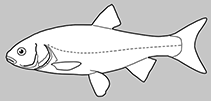
Rayons mous dorsaux (Total) : 11 - 12; Rayons mous anaux: 12 - 13; Vertèbres: 43. Chondrostoma esmaeilii can be diagnosed from other congeners in Iran and the Tigris-Euphrates river drainage by the following combination of characters: absence of a horny blade on
lower jaw; arched mouth; dorsal fin with 8 branched rays (9 in holotype); and anal fin with 10 branched rays; 51-58 lateral line scales (mean 53.8); 8-9 scales above lateral line 8-9 (mean 8.25), 5-6 scales below lateral line (mean 5.11); and 15-17 short gill rakers (mean 16.3) along the entire gill arch (Ref. 116747).
Inhabits Sarab-e Ravansar Stream with slow to medium current, 3-10 m width, up to 0.8 m maximum depth, muddy bed and in some parts sandy, and with dense vegetation. Co-occurs with Oxynoemacheilus kiabii, Carassius auratus, Alburnoides idignensis and Gambusia holbrooki (Ref. 116747).
Cycle de vie et comportement reproducteur
Maturité | Reproduction | Frai | Œufs | Fécondité | Larves
Eagderi, S., A. Jouladeh-Roudbar, S.S. Birecikligil, E. Cicek and B.W. Coad, 2017. Chondrostoma esmaeilii, a new cyprinid species from the Tigris river drainage in Iran (Teleostei: Cyprinidae). Verteb. Zool. 67(2):125-132. (Ref. 116747)
Statut dans la liste rouge de l'IUCN (Ref. 130435: Version 2025-2 (Global))
Menace pour l'homme
Harmless
Utilisations par l'homme
Outils
Articles particuliers
Télécharger en XML
Sources Internet
Estimations basées sur des modèles
Indice de diversité phylogénétique (Réf.
82804): PD
50 = 0.5000 [Uniqueness, from 0.5 = low to 2.0 = high].
Bayesian length-weight: a=0.00832 (0.00390 - 0.01775), b=3.09 (2.91 - 3.27), in cm total length, based on LWR estimates for this (Sub)family-body shape (Ref.
93245).
Niveau trophique (Réf.
69278): 2.6 ±0.1 se; based on size and trophs of closest relatives
Résilience (Réf.
120179): Milieu, temps minimum de doublement de population : 1,4 à 4,4 années (Preliminary K or Fecundity.).
Vulnérabilité de la pêche (Ref.
59153): Low vulnerability (10 of 100).
🛈