Élasmobranches (requins et raies) (sharks and rays) >
Squaliformes (Sleeper and dogfish sharks) >
Centrophoridae (Gulper sharks)
Etymology: Centrophorus: centr[um] (L.), prickle or sharp point; phorus, from phoreus (Gr.), bearer or carrier, referring to grooved spines on dorsal fins (See ETYFish); lesliei: In honor of Robin Leslie, Department of Agriculture, Forestry and Fisheries (South Africa), “who has contributed greatly to our knowledge of southern African chondrichthyans and provided numerous important specimens and tissue samples for various projects” (See ETYFish).
Eponymy: Dr Robin Leslie works for the Fisheries Branch, Department of Agriculture, Forestry and Fisheries in South Africa. [...] (Ref. 128868), visit book page.
Environnement : milieu / zone climatique / profondeur / gamme de distribution
Écologie
marin bathydémersal; profondeur 340 - 610 m (Ref. 116740). Tropical
Western Indian Ocean, Mozambique Channel (Madagascar and Mozambique), and off Senegal, Côte d’Ivoire, Equatorial Guinea, and Togo; Morocco, the Canary
Islands, and Ghana.
Taille / Poids / Âge
Maturité: Lm ? range ? - ? cm
Max length : 76.5 cm TL mâle / non sexé; (Ref. 116740); 99.0 cm TL (female)
Description synthétique
Clés d'identification | Morphologie | Morphométrie
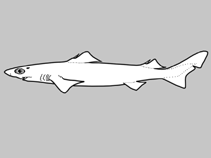
This medium sized (<1 m maximum total length) species is distinguished by the following set of characters: body relatively slender; head moderately long, 21.4-26.4% TL; snout relatively short, its horizontal preorbital length 6.5-8.2% TL, rounded in dorsal view; first dorsal very long with base length 16.8-19.7% TL and soft fin length 16.0-17.4% TL, and high with height 6.5-7.8% TL, its inner margin relatively short, 5.7-7.4% TL, 2.3–2.9 in soft fin length; second dorsal fin much smaller in area to first, similar in height to first dorsal fin, its height 1.0-1.3 in first dorsal-fin height; pectoral fins are large, anterior margin length 11.9-13.4% TL, free rear tip elongate in larger individuals, 2.4-4.8% TL; lateral trunk denticles of larger individuals are sessile or not raised on pedicels, block-like, not elevated; upper teeth of larger individuals have erect to slightly oblique cusps; lower teeth of all sized specimens are much larger than upper teeth, strongly oblique, blade-like; total vertebral centra 119-122; teeth 33–42/29–31 (Ref. 116740).
Cross section: oval.
Examined type specimens ranged in size from 31.7-95.0 cm TL, with the smallest free-swimming individual at 40.8 cm TL; a late-term embryo of 31.7 sm TL still with a small external yolk sac; an embryo of 39.5 cm TL from a pregnant female. A female of 86.3 cm TL was found to be mature and pregnant. Reported sizes of adult males 71.5-76.5 cm TL and adult females 89.0-99.0 cm TL (Ref. 116740).
Cycle de vie et comportement reproducteur
Maturité | Reproduction | Frai | Œufs | Fécondité | Larves
White, W.T., D.A. Ebert and G.J.P. Naylor, 2017. Revision of the genus Centrophorus (Squaliformes: Centrophoridae): Part 2 - Description of two new species of Centrophorus and clarification of the status of Centrophorus lusitanicus Barbosa du Bocage & de Brito Capello, 1864. Zootaxa 4344(1):086-114. (Ref. 116740)
Statut dans la liste rouge de l'IUCN (Ref. 130435: Version 2025-2 (Global))
Menace pour l'homme
Harmless
Utilisations par l'homme
Pêcheries: sans intérêt
Outils
Articles particuliers
Télécharger en XML
Sources Internet
Estimations basées sur des modèles
Indice de diversité phylogénétique (Réf.
82804): PD
50 = 0.5001 [Uniqueness, from 0.5 = low to 2.0 = high].
Bayesian length-weight: a=0.01122 (0.00514 - 0.02450), b=3.04 (2.87 - 3.21), in cm total length, based on all LWR estimates for this body shape (Ref.
93245).
Niveau trophique (Réf.
69278): 4.3 ±0.3 se; based on size and trophs of closest relatives
Résilience (Réf.
120179): Très faible, temps minimum de doublement de population supérieur à 14 ans (Preliminary K or Fecundity.).
Vulnérabilité de la pêche (Ref.
59153): High vulnerability (60 of 100).
🛈