>
Gobiesociformes (Clingfishes) >
Gobiesocidae (Clingfishes and singleslits) > Cheilobranchinae
Etymology: Nettorhamphos: Name from Greek 'netta' (duck) and 'rhamphos' (bill), referring to the curved bill; radula: Name from Latin 'radula', a tool used for scraping; referring to the many tiny conical teeth on the lingual surface of the premaxilla and dentary, reminiscent of the radula of a snail; noun in apposition.
Lingkungan: lingkungan / zona iklim / kisaran kedalaman / jangkauan distribusi
Ekologi
laut berasosiasi dengan karang; kisaran kedalaman 33 - 37 m (Ref. 116784). Tropical
Eastern Indian Ocean: Western Australia.
Ukuran / Berat / umur
Kematangan: Lm ? range ? - ? cm
Max length : 4.0 cm SL jantan/; (Ref. 116784)
deskripsi pendek
Kunci identifiaksi (pengenalan) | Morfologi | Morfometrik
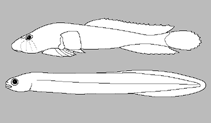
This species is distinguished by the following characters: unique features of oral jaws, including: an upper jaw which is much wider and longer than the lower jaw, creating a large gap between the outermost teeth of the upper jaw and those of the lower jaw (vs. upper and lower jaws similar in width and length and without obvious gap between outermost teeth of the upper jaw and those of the lower jaw or upper jaw only slightly wider and longer than the lower jaw creating a narrow gap between the outermost teeth of the upper jaw and those of the lower jaw); with tiny dagger-like conical teeth of uniform size arranged in multiple rows in both the upper (premaxilla; ca. 15 rows) and lower jaw (dentary; ca. 10 rows; vs. single row of conical teeth along the upper and lower jaws, a few short, staggered rows of incisiviform and/or conical teeth along both the upper and lower jaw, or conical teeth arranged in a broad patch anteriorly tapering to a single row posteriorly along both the upper and lower jaws); medial face of dentary without an anteromedially directed spine-like process; borad snout, rounded anteriorly, upper lip separated from snout by a shallow groove; adhesive disc double, with papillae present along the entire anterior margin of disc region A; patches of papillae on disc regions C and D; gill openings are large, joined across isthmus; presence of a well-developed spine laterally on head, formed by a heavily ossified subopercle; dorsal and anal fins are widely separated from caudal fin; dorsal fin with fewer fin rays compared to anal fin (Ref. 116784).
Body shape (shape guide): elongated; Cross section: oval.
Siklus hidup dan perilaku kawin
Kematangan | Reproduksi, perkembang biakan | Pemijahan | telur-telur | Fekunditas | Larva
Conway, K.W., G.I. Moore and A.P. Summers, 2017. A new genus and species of clingfish (Teleostei: Gobiesocidae) from Western Australia. Copeia 105(1):128-140. (Ref. 116784)
Status IUCN Red List (Ref. 130435: Version 2025-2 (Global))
ancaman kepada manusia
Harmless
penggunaan manusia
Perikanan: bycatch
Alat, peralatan
laporan khas
muat turun XML
Sumber internet
Estimasi berdasarkan model
Indeks keanekaragaman filogenetik (Acuan
82804): PD
50 = 1.0000 [Uniqueness, from 0.5 = low to 2.0 = high].
Bayesian length-weight: a=0.00389 (0.00180 - 0.00842), b=3.12 (2.94 - 3.30), in cm total length, based on all LWR estimates for this body shape (Ref.
93245).
Tingkat Trofik (Acuan
69278): 3.2 ±0.3 se; based on size and trophs of closest relatives
Daya lenting (Acuan
120179): Tinggi, Waktu penggandaan populasi minimum kurang dari 15 bulan (Preliminary K or Fecundity.).
Kerentanan Penangkapan Ikan (Ref.
59153): Low vulnerability (10 of 100).
🛈