>
Perciformes/Percoidei (Perchs) >
Percidae (Perches) > Etheostomatinae
Etymology: Etheostoma: Greek, etheo = to strain + Greek, stoma = mouth; Rafinesque said "various mouths", but Jordan and Evermann suggest the name might have been intended as "Heterostoma (Ref. 45335).
Entorno: milieu / zona climática / rango de profundidad / gama de distribución
Ecología
; agua dulce bentopelágico. Subtropical
North America: Upland streams on the Cumberland Plateau in the upper Bear Creek system (Tennessee River drainage) and the Hubbard Creek system (Mobile Basin) in Alabama, USA.
Tamaño / Peso / Edad
Madurez: Lm ? range ? - ? cm
Max length : 4.9 cm SL macho / no sexado; (Ref. 116751)
Descripción breve
Claves de identificación | Morfología | Morfometría
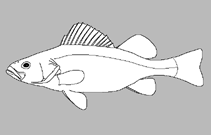
Espinas dorsales (total) : 9 - 12; Radios blandos dorsales (total) : 10 - 12; Espinas anales: 2; Radios blandos anales: 7 - 9. Etheostoma cyanoprosopum is distinguished by the following characters: lateral line complete with 45 to 53 scales; 11 to 17 transverse scale rows ; 16 to 20 scales around the caudal peduncle 16 to 20 ; dorsal fin with modally 10 spines and 12 rays; anal fin with 2 spines and 7 to 9 soft rays; pectoral fin with modally 14 rays; nape, belly, and prepectoral area are scaled; breast naked in most specimens; nine lateral blotches of pigment on side of body, 8 to 10 dorsal saddles, a narrow suborbital bar; spinous dorsal fin with three distinct color bands in nuptial males; a distal-most thin turquoise band, a medial band of dark red, and a basal-most band of black spots; second dorsal fin with blue color on distal third and a more basal red band limited to the posterior two-thirds of the fin. Nuptial males possess a turquoise to darker blue color on the pelvic fins, caudal fin, and margin of the anal fin. A turquoise color on the breast extends to the underside of the head, snout, and cheeks. A pale white line extends along the lateral line to the middle of the second dorsal fin. Absence of a red ocellus in the first interradial membrane of the first dorsal fin in both males and females (Ref. 116751).
Ciclo vital y comportamiento de apareamiento
Madurez | Reproducción | Puesta | Huevos | Fecundidad | Larva
Kozal, L.C., J.W. Simmons, J.M. Mollish, D.J. MacGuigan, E. Benavides, B.P. Keck and T.J. Near, 2017. Phylogenetic and morphological diversity of the Etheostoma zonistium species complex with the description of a new species endemic to the cumberland plateau of Alabama. Bulletin of the Peabody Museum of Natural History 58(2):263-286. (Ref. 116751)
Situación en la Lista Roja de la UICN (Ref. 130435: Version 2025-2 (Global))
Amenaza para el ser humano
Harmless
Usos humanos
Herramientas
Informes especiales
Descargar XML
Fuentes de Internet
Estimaciones basadas en modelos
Índice de diversidad filogenética (Referencia
82804): PD
50 = 0.5000 [Uniqueness, from 0.5 = low to 2.0 = high].
Bayesian length-weight: a=0.00676 (0.00303 - 0.01510), b=3.12 (2.94 - 3.30), in cm total length, based on LWR estimates for this Genus-body shape (Ref.
93245).
Nivel trófico (Referencia
69278): 3.2 ±0.5 se; based on size and trophs of closest relatives
Resiliencia (Referencia
120179): Alto, población duplicada en un tiempo mínimo inferior a 15 meses (Preliminary K or Fecundity.).
Vulnerabilidad pesquera (Ref.
59153): Low vulnerability (10 of 100).
🛈