分類 / 名前
共通名の | 類義語 | Catalog of Fishes(部類, 種) | ITIS | CoL | WoRMS | Cloffa
>
Gymnotiformes (Knifefishes) >
Hypopomidae (Bluntnose knifefishes)
Etymology: Brachyhypopomus: Greek, brachys, eia = short + Greek, hypo = under + Greek, poma, -atos = cover (Ref. 45335); alberti: Named for James S. Albert, American (USA) ichthyologist, collector of part of the type series, for his enormous contributions to the systematic biology of gymnotiform fishes.
Eponymy: Dr James Spurling Albert (d: 1964) is a biologist and ichthyologist who is Professor in the Department of Biology (2015) at the University of Louisiana, Lafayette. [...] (Ref. 128868), visit book page.
環境:環境 / 気候帯 / 深さの範囲 / 分布範囲
生態学
; 新鮮な水 底生の漂泳性; pH range: 5.2 - 5.5. Tropical; 22°C - 24°C (Ref. 116763)
South America: upper rio Madeira basin in Brazil and Bolivia.
サイズ / 重さ / 年齢
成熟: Lm ? range ? - ? cm
Max length : 11.1 cm TL オス/雌雄の選別がない; (Ref. 116763); 10.0 cm TL (female)
簡単な記述
検索表 | 形態学 | 形態計測学
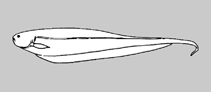
臀鰭: 172 - 191. Brachyhypopomus alberti is distinguished from other species of the genus Brachyhypopomus by the following combination of characters: absence of depigmented stripe along middorsal region of body (vs. prominent pale uninterrupted middorsal stripe from occipital region to base of caudal filament in B. arrayae, B. beebei, B. belindae, B. gauderio, B. pinnicaudatus, and B. verdii); 20-22 precaudal vertebrae (vs. 15-19 in B. batesi, B. benjamini, B. bennetti, B. bombilla, B. bullocki, B. cunia, B. diazi, B. hendersoni, B. menezesi, B. provenzanoi, B. regani, and B. sullivani); anal fin with 182-202 rays (vs. 226-293 in B. brevirostris); presence of continuous or discontinuous dark vertical or diagonally oriented bands or saddles on body surface dorsal to lateral line, often extending across lateral line into ventral lateral surface (vs. absence of oblique bands or saddles on body surface dorsal to lateral line in B. draco, B. flavipomus, B. jureiae, and B. palenque); 3 bilateral columns of electrocytes at the anal-fin terminus (vs. 4-5 in B. janeiroensis and B. occidentalis (except some populations in Colombia and Venezuela); absence of dark suborbital stripe (vs. presence in B. walteri). It differs from most but not all specimens of B. hamiltoni by having a higher number of pectoral-fin rays 15-16 (mode 16) (vs. 12-15 (mode 13) (only 2 of 18 measured specimens of B. hamiltoni exhibited an overlapping number of pectoral-fin rays with B. alberti). It can be differentiated from B. hamiltoni by the absence of the first of five branchiostegal rays (vs. presence in B. hamiltoni Mago-Leccia) (Ref. 116763).
Body shape (shape guide): elongated.
Facultative air-breathing in the genus (Ref. 126274); The type series was sampled in tropical forest and savanna near Riberalta, Bolivia from small low-conductivity clearwater and blackwater terra firme streams. Found mostly commonly in marginal root mats, and in emergent or submerged aquatic vegetation. Recorded water parameters at the sampling sites included the following: conductivity 5-15 μS/cm, dissolved oxygen 3.0-5.0 mg/l, temperature 22-24°C, and pH 5.2-5.5. Co-inhabits in geographical sympatry and ecological syntopy with the following species occurring in terra firme stream: B. brevirostris, B. sullivani, and B. walteri. In the region of the type locality, it is allotopic with whitewater floodplain species such as B. arrayae, B. bombilla, and B. pinnicaudatus. It co-occurs in geographical sympatry with its sister species B. arrayae, but the species exhibit a noteworthy difference in ecological distribution. B. alberti occupies the low conductivity (ca. 5-15 μScm-1) terra firme forest and savanna streams, while B. arrayae mainly inhabits higher-conductivity whitewater floodplain systems (ca. 150 μScm-1 at the time of sampling). B. alberti was collected together with B. arrayae (and also B. pinnicaudatus) in the lower reaches of terra firme streams, at the ecotone with the río Beni floodplain (Ref. 116763).
ライフサイクルと交尾行動
成熟 | 繁殖 | 放精 | 卵 | 生産力 | 幼生
Crampton, W.G.R., C.D. de Santana, J.C. Waddell and N.R. Lovejoy, 2017. A taxonomic revision of the Neotropical electric fish genus Brachyhypopomus (Ostariophysi: Gymnotiformes: Hypopomidae), with descriptions of 15 new species. Neotrop. ichthyol. 14(4):e150146. (Ref. 116763)
IUCNのレッドリストの状況は (Ref. 130435: Version 2025-2 (Global))
人間の用途
水産業: 興味がない
用具
特記事項
XMLをダウンロードして下さい
インターネットの情報源
モデルに基づく推定値
系統多様性指数 (参照
82804): PD
50 = 0.5000 [Uniqueness, from 0.5 = low to 2.0 = high].
Bayesian length-weight: a=0.00372 (0.00141 - 0.00980), b=3.06 (2.83 - 3.29), in cm total length, based on LWR estimates for this (Sub)family-body shape (Ref.
93245).
栄養段階 (参照
69278): 3.1 ±0.4 se; based on size and trophs of closest relatives
漁業の脆弱性 (Ref.
59153): Low vulnerability (10 of 100).
🛈