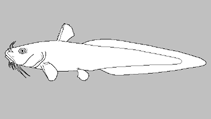
Classificazione / Nomi
Nomi Comuni | Sinonimi | Catalog of Fishes(Genere, Specie) | ITIS | CoL | WoRMS | Cloffa
>
Siluriformes (Catfishes) >
Plotosidae (Eeltail catfishes)
Etymology: Tandanus: A local name, tandan, in Australia; bellingerensis: The specific name bellingerensis is in reference to the Bellinger River drainage, where this taxon was first recognized as an undescribed species based on genetic evidence.
Ambiente: milieu / zona climatica / distribuzione batimetrica / gamma di distribuzione
Ecologia
; acqua dolce demersale. Tropical
Oceania: Bellinger, Macleay, Hastings, and Manning drainage basins in New South Wales, Australia.
Dimensione / Peso / Età
Maturità: Lm ? range ? - ? cm
Max length : 45.2 cm SL maschio/sesso non determinato; (Ref. 116005)
Breve descrizione
Chiavi di identificazione | Morfologia | Morfometria
Raggi dorsali molli (totale) : 5 - 6. Tandanus bellingerensis is distinguished from all its congeners (T. tandanus; T. tandanus; T. tropicanus; and T. bostocki) by the following combination of characters: 153-169, mode 159, rays in the continuous caudodorsal and anal fins; 35-39, mode 36, gill rakers on the first arch; and strongly recurved serrae on the posterior side of the pectoral-fin spine, which point to the distal end of the spine shaft. To a lesser degree, it also differs from T. tandanus of the MDB and eastern coastal drainages of Australia by a longer distance between the bases of the maxillary barbels (45.8-59.5% of SL, mean 53.2% vs. 39.5-48.8%, mean 44.9% and 37.2-48.9%, mean 42.8%, respectively). It can be further differentiated from T. tropicanus by having a smaller eye diameter (11.4-14.5% of HL, mean 13.5% vs. 14.7-18.5%, mean 16.3%, respectively) and, to a lesser degree, a shorter pectoral spine (8.8-11.8% of SL, mean 10.4% vs. 11.1-14.0%, mean 12.4%, respectively). It possesses brown or gray pigmentation on the lateral side of the head just posterior of the mouth, whereas T. tropicanus has a creamy-white or dirty-white patch extending ventrolaterally just posterior of the mouth. It further differs from T. bostocki by having a shorter post-orbital distance (37.9-42.3% of HL, mean 39.5% vs. 46.7-55.9%, mean 51.9%, respectively), a longer snout (48.6-54.5% of HL, mean 51.8% vs. 37.6-42.1%, mean 39.8%, respectively), and, to a lesser degree, a larger mouth gape (42.2-52.1% of HL, mean 48.1% vs. 32.5-42.4%, mean 38.3%, respectively) (Ref. 116005).
Based on altitude zone, this species is common to the coastal plain (3-30 m), lowland (31-200 m), and slopes (201-400 m) but occurs occasionally in upland areas (401-700m), and rarely in highlands (701-1,100 m) (Ref. 116005).
Ciclo vitale e comportamento di accoppiamento
Maturità | Riproduzione | Deposizione | Uova | Fecondità | Larve
Welsh, S.A., D.R. Jerry, D.W. Burrows and M.L. Rourke, 2017. A new species of freshwater eel-tailed catfish of the genus Tandanus (Teleostei: Plotosidae) from coastal rivers of mid-northern New South Wales, Australia. Copeia 105(2):229-236. (Ref. 116005)
Stato della Lista Rossa IUCN (Ref. 130435: Version 2025-2 (Global))
Minaccia per l'uomo
Harmless
Usi umani
Strumenti
Rapporti speciali
Scarica XML
Fonti Internet
Stime basate su modelli
Indice di diversità filogenetica (Fonte Biblio.
82804): PD
50 = 0.5625 [Uniqueness, from 0.5 = low to 2.0 = high].
Bayesian length-weight: a=0.00724 (0.00299 - 0.01755), b=3.09 (2.89 - 3.29), in cm total length, based on LWR estimates for this (Sub)family-body shape (Ref.
93245).
Livello trofico (Fonte Biblio.
69278): 3.5 ±0.6 se; based on size and trophs of closest relatives
Resilienza (Fonte Biblio.
120179): Medio, tempo minimo di raddoppiamento della popolazione 1.4 - 4.4 anni (Preliminary K or Fecundity.).
Vulnerabilità della pesca (Ref.
59153): Moderate vulnerability (42 of 100).
🛈