Classificazione / Nomi
Nomi Comuni | Sinonimi | Catalog of Fishes(Genere, Specie) | ITIS | CoL | WoRMS | Cloffa
>
Siluriformes (Catfishes) >
Aspredinidae (Banjo catfishes) > Aspredininae
Etymology: Xyliphius: Greek, xylephion, xylarion = a little piece of wood (Ref. 45335); sofiae: Named for the daughter of first author on the specific epithet, for inspiring wisdom in her father.
Ambiente: milieu / zona climatica / distribuzione batimetrica / gamma di distribuzione
Ecologia
; acqua dolce demersale. Tropical
South America: Amazon River in Peru.
Dimensione / Peso / Età
Maturità: Lm ? range ? - ? cm
Max length : 4.4 cm SL maschio/sesso non determinato; (Ref. 116022)
Breve descrizione
Chiavi di identificazione | Morfologia | Morfometria
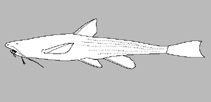
Spine dorsali (totale) : 1; Raggi dorsali molli (totale) : 4; Raggi anali molli: 9. Xyliphius sofiae can be diagnosed from all its congeners by four autapomorphies: absence of eyes (vs. presence, though reduced); color pale, lack of pigment (vs. head and body darkly pigmented); 5 branchiostegal rays (vs. 4); and unculiferous tubercles on posterior body evenly distributed (vs. enlarged unculiferous tubercles typically arranged in five distinct rows from above pelvic-fin base to posterior end of caudal peduncle). It further differs by having one ossified proximal radial in the pectoral fin (vs. two in congeners, except X. magdalenae, not examined). It can be distinguished from all congeners except X. lepturusby having the snout tip elongated and narrowly rounded (vs. short and broadly rounded, often with small median notch), fifth ceratobranchial relatively narrow with two or three irregular rows of acicular teeth (vs. broadly expanded with larger conical teeth), anterior limits of the branchial apertures separated by a distance smaller than length of aperture (vs. greater than length of aperture), anal-fin rays modally nine (vs. seven), and lateral line extending onto base of caudal-fin rays (vs. finishing in hypural region) (Ref. 116022).
Body shape (shape guide): elongated.
Inhabits river. Caught with a large floating net stretched between two canoes and dragged downstream through the water column (Ref. 116022).
Ciclo vitale e comportamento di accoppiamento
Maturità | Riproduzione | Deposizione | Uova | Fecondità | Larve
Carvalho, T.P., R.E. Reis and M.H. Sabaj, 2017. Description of a new blind and rare species of Xyliphius (Siluriformes: Aspredinidae) from the Amazon basin using high-resolution computed tomography. Copeia 105(2):14-28. (Ref. 116022)
Stato della Lista Rossa IUCN (Ref. 130435: Version 2025-2 (Global))
Minaccia per l'uomo
Harmless
Usi umani
Strumenti
Rapporti speciali
Scarica XML
Fonti Internet
Stime basate su modelli
Indice di diversità filogenetica (Fonte Biblio.
82804): PD
50 = 0.5078 [Uniqueness, from 0.5 = low to 2.0 = high].
Bayesian length-weight: a=0.00324 (0.00137 - 0.00763), b=3.02 (2.81 - 3.23), in cm total length, based on LWR estimates for this (Sub)family-body shape (Ref.
93245).
Livello trofico (Fonte Biblio.
69278): 3.1 ±0.3 se; based on size and trophs of closest relatives
Vulnerabilità della pesca (Ref.
59153): Low vulnerability (10 of 100).
🛈