>
Acropomatiformes (Oceanic basses) >
Pempheridae (Sweepers)
Etymology: Pempheris: Greek, pempheris = the name of a fish (Ref. 45335); convexa: Name from Latin, referring to the strongly rounded dorsal profile of the head.
Environnement : milieu / zone climatique / profondeur / gamme de distribution
Écologie
marin récifal; profondeur 1 - 10 m (Ref. 97766). Tropical
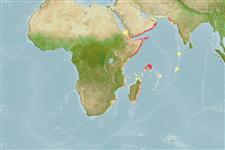
Western Indian Ocean: Oman (Arabian Sea) and the Maldives.
Taille / Poids / Âge
Maturité: Lm ? range ? - ? cm
Max length : 11.8 cm SL mâle / non sexé; (Ref. 97766)
Description synthétique
Clés d'identification | Morphologie | Morphométrie
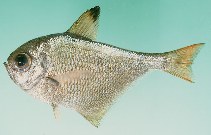
Épines dorsales (Total) : 6; Rayons mous dorsaux (Total) : 9; Épines anales: 3; Rayons mous anaux: 39 - 40; Vertèbres: 25. This species is distinguished by the following characters: D VI,9; A III,39-40; pectoral rays 17-19; lateral-line scales 52-56; ctenoid scales on side of chest, nape, and body below dorsal fin to the scale row above lateral line; scaled caudal fin on about basal fourth; gill rakers 29-31; body depth 2.0-2.1 in SL; head length 3.3-3.4 in SL; dorsal profile of head strongly convex; relatively small eye, orbit diameter 8.0-8.5 in SL; caudal-fin length 3.65-3.85 in SL, moderately emarginate, with caudal concavity 3.65-4.1 in head length; pectoral-fin length 3.3-3.4 in SL; color in alcohol yellowish to orangish brown; dorsal fin with brownish yellow rays, translucent yellow membranes, and a large blackish spot distally on posterior spines and anterior soft rays; anal fin with basal fourth dark reddish brown, a broad brownish yellow zone, and a narrow whitish border, except fin anterior to about fifth soft ray darker brown; caudal fin brown on scaled basal part, brownish yellow distally; paired fins brownish yellow; dark bluish gray iris with brown pupil (Ref. 97766).
Body shape (shape guide): short and / or deep.
Occupies different habitats, where 3 individuals were taken from 3 different areas a coral reef, a rock wall in a small boat harbor, or from a large surge channel which is fully exposed to the open sea (Ref. 97766).
Cycle de vie et comportement reproducteur
Maturité | Reproduction | Frai | Œufs | Fécondité | Larves
Randall, J.E. and B.C. Victor, 2014. Four new fishes of the genus Pempheris (Perciformes: Pempheridae) from the western Indian Ocean. J. Ocean Sci. Found. 12:61-83. (Ref. 97766)
Statut dans la liste rouge de l'IUCN (Ref. 130435: Version 2025-2 (Global))
Menace pour l'homme
Harmless
Utilisations par l'homme
Outils
Articles particuliers
Télécharger en XML
Sources Internet
Estimations basées sur des modèles
Indice de diversité phylogénétique (Réf.
82804): PD
50 = 0.5000 [Uniqueness, from 0.5 = low to 2.0 = high].
Bayesian length-weight: a=0.01380 (0.00586 - 0.03254), b=3.01 (2.82 - 3.20), in cm total length, based on LWR estimates for this Genus-body shape (Ref.
93245).
Niveau trophique (Réf.
69278): 3.4 ±0.5 se; based on size and trophs of closest relatives
Résilience (Réf.
120179): Haut, temps minimum de doublement de population inférieur à 15 mois (Preliminary K or Fecundity.).
Vulnérabilité de la pêche (Ref.
59153): Low vulnerability (10 of 100).
🛈