Holocéphales (chimères) (chimaeras) >
Chimaeriformes (Chimaeras) >
Chimaeridae (Shortnose chimaeras or ratfishes)
Etymology: Hydrolagus: hydro-, combining form of hydor (Gr.), water; lagos (Gr.), hare, i.e., “water rabbit,” probably referring to three pairs of tooth plates, which tend to protrude from the mouth like a rabbit’s incisors (See ETYFish); erithacus: Erithacus, avian genus of the robin, named after Robin Leslie, South African Department of Agriculture, Forestry and Fisheries, a “fanatic birder,” for his help and support with the authors’ project and his overall contribution to Chondrichthyan re (See ETYFish).
Environnement : milieu / zone climatique / profondeur / gamme de distribution
Écologie
marin bathydémersal; profondeur 470 - 1000 m (Ref. 116866). Deep-water; 39°S - 47°S (Ref. 116866)
Distribution
Territoires | Zones FAO | Écosystèmes | Occurrences | Carte par point | Introductions | Faunafri
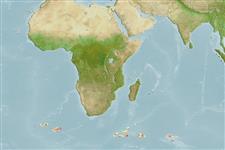
Southeastern Atlantic and southwestern Indian oceans: Discovery Seamount. High Seas only.
Taille / Poids / Âge
Maturité: Lm ? range ? - ? cm
Max length : 132 cm TL mâle / non sexé; (Ref. 116866); 144.2 cm TL (female)
Description synthétique
Clés d'identification | Morphologie | Morphométrie
This species is distinguished from its congeners by the following set of characters: bulky and relatively large head is followed by a stocky body; head and body height consistent from about pectoral fin origins to pelvic fin origins, until the insertion of the pelvic fins, tapering rapidly to filamentous tail; height of first dorsal fin spine about equal to or slightly less than first dorsal fin apex height; second dorsal fin up to 81% of total body length, uniform in height, and equal to dorsal caudal fin height; paired claspers trifurcate, forked for approximately 20% of total length with fleshy, bulbous tips; prepelvic tenaculae with 5-7 medial spines; robust frontal tenaculum, nearly uniform in width; color when preserved uniform black with no distinct markings (Ref. 116866).
Body shape (shape guide): elongated; Cross section: angular.
This species is likely to occur beyond 2,000 meters. Fragments of possible crab appendages recovered from a digestive tract indicate a diet of crustaceans and other benthic fauna (Ref. 116866).
Cycle de vie et comportement reproducteur
Maturité | Reproduction | Frai | Œufs | Fécondité | Larves
Walovich, K.A., D.A> Ebert and J.M. Kemper, 2017. Hydrolagus erithacus sp. nov. (Chimaeriformes: Chimaeridae), a new species of chimaerid from the southeastern Atlantic and southwestern Indian oceans. Zootaxa 4226(4):509-520. (Ref. 116866)
Statut dans la liste rouge de l'IUCN (Ref. 130435: Version 2025-2 (Global))
Menace pour l'homme
Harmless
Utilisations par l'homme
Pêcheries: sans intérêt
Outils
Articles particuliers
Télécharger en XML
Sources Internet
Estimations basées sur des modèles
Indice de diversité phylogénétique (Réf.
82804): PD
50 = 0.5000 [Uniqueness, from 0.5 = low to 2.0 = high].
Bayesian length-weight: a=0.00339 (0.00139 - 0.00824), b=3.07 (2.86 - 3.28), in cm total length, based on LWR estimates for this (Sub)family-body shape (Ref.
93245).
Niveau trophique (Réf.
69278): 4.0 ±0.6 se; based on size and trophs of closest relatives
Résilience (Réf.
120179): Très faible, temps minimum de doublement de population supérieur à 14 ans (Preliminary K or Fecundity.).
Vulnérabilité de la pêche (Ref.
59153): Very high vulnerability (87 of 100).
🛈