Classification / Noms
Noms communs | Synonymes | Catalog of Fishes(Genre, Espèce) | ITIS | CoL | WoRMS | Cloffa
>
Gymnotiformes (Knifefishes) >
Hypopomidae (Bluntnose knifefishes)
Etymology: Brachyhypopomus: Greek, brachys, eia = short + Greek, hypo = under + Greek, poma, -atos = cover (Ref. 45335); belindae: Named for Belinda Siew-Woon Chang, American (USA) evolutionary biologist, for her inspiration to N.R. Lovejoy during the preparation of this work.
Eponymy: Dr Belinda Siew-Woon Chang is a biologist who became Associate Professor of Ecology and Evolutionary Biology at the University of Toronto, Canada (2003). [...] (Ref. 128868), visit book page.
Environnement : milieu / zone climatique / profondeur / gamme de distribution
Écologie
; eau douce benthopélagique; pH range: 6.3 - 7.3. Tropical; 27°C - 34°C (Ref. 116763)
South America: central Amazon River basin, Brazil.
Taille / Poids / Âge
Maturité: Lm ? range ? - ? cm
Max length : 11.0 cm TL mâle / non sexé; (Ref. 116763)
Description synthétique
Clés d'identification | Morphologie | Morphométrie
Rayons mous anaux: 200 - 220. Brachyhypopomus belindae can be distinguished from congeners by having 24-26 precaudal vertebrae (vs. 15-23 in all congeners except B. draco, and B. verdii) and bilateral columns of electrocytes at the anal-fin terminus 4-5 (no mode, median 4.5) (vs. 3 in B. draco and B. verdii (Ref. 116763).
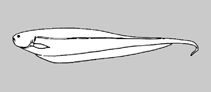
Body shape (shape guide): elongated.
Facultative air-breathing in the genus (Ref. 126274); Occurs only in whitewater floodplain habitats. Co-exists in geographical sympatry and ecological syntopy with the following species occurring in whitewater floodplain. The recorded water parameters at the sites near the type locality, through an entire annual flood cycle were the following: conductivity 54-192 μS/cm; dissolved oxygen 0-6.3 mg/l, temperature 26.5-34.0°C, and pH 6.3-7.3. Feeds on aquatic insect larvae and other small aquatic invertebrates in the type locality (Ref. 116763).
Cycle de vie et comportement reproducteur
Maturité | Reproduction | Frai | Œufs | Fécondité | Larves
Crampton, W.G.R., C.D. de Santana, J.C. Waddell and N.R. Lovejoy, 2017. A taxonomic revision of the Neotropical electric fish genus Brachyhypopomus (Ostariophysi: Gymnotiformes: Hypopomidae), with descriptions of 15 new species. Neotrop. ichthyol. 14(4):e150146. (Ref. 116763)
Statut dans la liste rouge de l'IUCN (Ref. 130435: Version 2025-2 (Global))
Menace pour l'homme
Harmless
Utilisations par l'homme
Pêcheries: sans intérêt
Outils
Articles particuliers
Télécharger en XML
Sources Internet
Estimations basées sur des modèles
Indice de diversité phylogénétique (Réf.
82804): PD
50 = 0.5000 [Uniqueness, from 0.5 = low to 2.0 = high].
Bayesian length-weight: a=0.00372 (0.00141 - 0.00980), b=3.06 (2.83 - 3.29), in cm total length, based on LWR estimates for this (Sub)family-body shape (Ref.
93245).
Niveau trophique (Réf.
69278): 3.1 ±0.4 se; based on size and trophs of closest relatives
Vulnérabilité de la pêche (Ref.
59153): Low vulnerability (10 of 100).
🛈