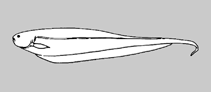
การจำแนกประเภท / ชื่อ
ชื่อสามัญ | ชื่อพ้อง | Catalog of Fishes(สกุล, ชนิด) | ITIS | CoL | WoRMS | Cloffa
>
Gymnotiformes (Knifefishes) >
Hypopomidae (Bluntnose knifefishes)
Etymology: Brachyhypopomus: Greek, brachys, eia = short + Greek, hypo = under + Greek, poma, -atos = cover (Ref. 45335); flavipomus: Derived from the Latin adjective flavus (yellow); and from pomus, latinized from Greek πῶμα =
lid, cover, in reference to the conspicuous patches of yellow guanine on the operculum of live individuals.
สิ่งแวดล้อม : สิ่งแวดล้อม / เขตภูมิอากาศ / ระดับความลึก / ระยะการกระจายสินค้า
นิเวศวิทยา
; น้ำจืด กลุ่มสัตว์หน้าดิน,กลุ่มสัตว์พื้นท้องน้ำ. Tropical
South America: Brazil, Colombia, and Peru.
ขนาด / น้ำหนัก / อายุ
วัยเจริญพันธุ์: Lm ? range ? - ? cm
Max length : 11.7 cm TL (female)
คำอธิบายสั้นๆ
เครื่องมือที่ใช้ในการแยกชนิดสัตว์,สิ่งมีชีวิตออกจากกัน | สัณฐานวิทยา | ความยาวต่างๆ
ก้านครีบอ่อนที่ก้น: 175 - 186. Brachyhypopomus flavipomus can be distinguished by having conspicuous patches of shiny yellow guanine on the operculum and anterior to pectoral-fin base in live individuals (vs. absent in all congeners) (Ref. 116763).
Body shape (shape guide): elongated.
Facultative air-breathing in the genus (Ref. 126274); Occurs only in whitewater floodplain habitats where it is observed throughout the year in floating macrophytes. Most abundant in sheltered floodplain lakes surrounded by high levee forest, but has a patchy distribution, and varies in abundance at a given site from year to year. Occurs sympatrically and syntopically in whitewater floodplain with the following congeners: Brachyhypopomus beebei, B. belindae, B. bennetti, B. brevirostris, B. hamiltoni, B. pinnicaudatus, B. regani, and B. walteri. Exhibits allotopic distributions across parts of its range with Brachyhypopomus batesi, B. benjamini¸ B. hendersoni, B. sullivani, and B. verdii. Feeds on aquatic insect larvae, microcrustacea, and other small aquatic invertebrates, with a predominance of Chironomidae larvae in the type locality (Ref. 116763).
วงจรชีวิตและพฤติกรรมการผสมพันธุ์
วัยเจริญพันธุ์ | การสืบพันธุ์ | การวางไข่ | เซลสืบพันธ์ของเพศเมีย(ไข่) | ความดกของไข่ | ตัวอ่อน
Crampton, W.G.R., C.D. de Santana, J.C. Waddell and N.R. Lovejoy, 2017. A taxonomic revision of the Neotropical electric fish genus Brachyhypopomus (Ostariophysi: Gymnotiformes: Hypopomidae), with descriptions of 15 new species. Neotrop. ichthyol. 14(4):e150146. (Ref. 116763)
สถานะบัญชีแดงของ IUCN (Ref. 130435: Version 2025-2 (Global))
ภัยคุกคามต่อมนุษย์
Harmless
การใช้ของมนุษย์
การประมง: ไม่มีผลประโยชน์
เครื่องมือ
รายงานพิเศษ
ดาวน์โหลด XML
แหล่งที่มาจากอินเตอร์เน็ต
การประมาณค่าตามแบบจำลอง
ดัชนีความหลากหลายทางวิวัฒนาการ (อ้างอิง
82804): PD
50 = 0.5000 [Uniqueness, from 0.5 = low to 2.0 = high].
Bayesian length-weight: a=0.00372 (0.00141 - 0.00980), b=3.06 (2.83 - 3.29), in cm total length, based on LWR estimates for this (Sub)family-body shape (Ref.
93245).
ระดับชั้นอาหาร (อ้างอิง
69278): 3.1 ±0.4 se; based on size and trophs of closest relatives
ความเสี่ยงต่อการตกปลา (Ref.
59153): Low vulnerability (10 of 100).
🛈