Classificazione / Nomi
Nomi Comuni | Sinonimi | Catalog of Fishes(Genere, Specie) | ITIS | CoL | WoRMS | Cloffa
>
Gymnotiformes (Knifefishes) >
Hypopomidae (Bluntnose knifefishes)
Etymology: Brachyhypopomus: Greek, brachys, eia = short + Greek, hypo = under + Greek, poma, -atos = cover (Ref. 45335); hendersoni: Named for Peter A. Henderson, British fish biologist, and doctoral co-advisor of WGRC, for his
contributions to Amazonian aquatic ecology.
Eponymy: Dr Peter Alan Henderson (d: 1954) is a British fish biologist. [...] (Ref. 128868), visit book page.
Ambiente: milieu / zona climatica / distribuzione batimetrica / gamma di distribuzione
Ecologia
; acqua dolce benthopelagico; pH range: 5.3 - 6.7. Tropical; 29°C - 33°C (Ref. 116763)
South America: central Amazon and lower Negro in Brazil; and Essequibo drainage in Guyana.
Dimensione / Peso / Età
Maturità: Lm ? range ? - ? cm
Max length : 19.5 cm TL maschio/sesso non determinato; (Ref. 116763); 20.3 cm TL (female)
Breve descrizione
Chiavi di identificazione | Morfologia | Morfometria
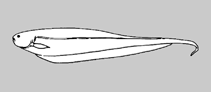
Raggi anali molli: 192 - 210. Brachyhypopomus hendersoni is distinguished from other species of the genus Brachyhypopomus by the following combination of characters: caudal filament length 32.3-64.5% length to end of anal fin (vs. 7.4-31.6% in B. alberti, B. arrayae, B. batesi, B. belindae, B. benjamini, B. bennetti, B. bombilla, B. hamiltoni, B. occidentalis, B. palenque, B. provenzanoi, B. regani, B. sullivani, and B. verdii); 15-17 precaudal vertebrae (vs. 18-25 in B. beebei, B. brevirostris, B. draco, B. flavipomus, B. gauderio, B. janeiroensis, B. jureiae, and B. pinnicaudatus); head width at occiput 39.2-47.8% HL (vs. 49.5-70.4% in B. bullocki, B. diazi, and B. menezesi); and dorsal rami of the recurrent branch of the anterior lateral line nerve not visible (vs. visible in B. cunia and B. walteri) (Ref. 116763).
Body shape (shape guide): elongated.
Facultative air-breathing in the genus (Ref. 126274); In the type locality region, this species occurs usually in marginal emergent plants (mainly wild rice, Oryza spp.), rafts of floating macrophytes (including grasses, e.g., Paspalum, and water hyacinths, Eichhornia spp.), and decaying plant matter along the edges of low-conductivity blackwater floodplain ria lakes (e.g., lago Tefé, lago Amanã, and lago Caiambé), and along river and oxbow lake margins. Feeds on aquatic insect larvae (primarily Chironomidae), and other
small aquatic invertebrates in the type locality. Spawns in floating macrophytes during the rising and high water period (Ref. 116763).
Ciclo vitale e comportamento di accoppiamento
Maturità | Riproduzione | Deposizione | Uova | Fecondità | Larve
Crampton, W.G.R., C.D. de Santana, J.C. Waddell and N.R. Lovejoy, 2017. A taxonomic revision of the Neotropical electric fish genus Brachyhypopomus (Ostariophysi: Gymnotiformes: Hypopomidae), with descriptions of 15 new species. Neotrop. ichthyol. 14(4):e150146. (Ref. 116763)
Stato della Lista Rossa IUCN (Ref. 130435: Version 2025-2 (Global))
Minaccia per l'uomo
Harmless
Usi umani
Pesca: di nessun interesse
Strumenti
Rapporti speciali
Scarica XML
Fonti Internet
Stime basate su modelli
Indice di diversità filogenetica (Fonte Biblio.
82804): PD
50 = 0.5000 [Uniqueness, from 0.5 = low to 2.0 = high].
Bayesian length-weight: a=0.00372 (0.00141 - 0.00980), b=3.06 (2.83 - 3.29), in cm total length, based on LWR estimates for this (Sub)family-body shape (Ref.
93245).
Livello trofico (Fonte Biblio.
69278): 3.2 ±0.4 se; based on size and trophs of closest relatives
Vulnerabilità della pesca (Ref.
59153): Low vulnerability (10 of 100).
🛈