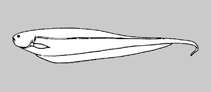
>
Gymnotiformes (Knifefishes) >
Hypopomidae (Bluntnose knifefishes)
Etymology: Brachyhypopomus: Greek, brachys, eia = short + Greek, hypo = under + Greek, poma, -atos = cover (Ref. 45335); palenque: Derived from the río Palenque, a Pacific Ocean drainage of Ecuador, where the type series was collected. A noun in apposition.
Entorno: milieu / zona climática / rango de profundidad / gama de distribución
Ecología
; agua dulce bentopelágico; pH range: 6.5 - ?. Tropical; 24°C - 24°C (Ref. 116763)
South America: Ecuador.
Tamaño / Peso / Edad
Madurez: Lm ? range ? - ? cm
Max length : 20.3 cm TL macho / no sexado; (Ref. 116763); 15.7 cm TL (female)
Descripción breve
Claves de identificación | Morfología | Morfometría
Radios blandos anales: 180 - 229. Brachyhypopomus palenque is distinguished from other species of the genus Brachyhypopomus by the following combination of characters: caudal filament length 7.4-14.0% of length to end of anal fin (vs. 14.1-83.1% in B. alberti, B. batesi, B. benjamini, B. brevirostris, B. bullocki, B. cunia, B. draco, B. gauderio, B. hamiltoni, B. hendersoni, B. janeiroensis, B. jureiae, B. menezesi, B. pinnicaudatus, B. provenzanoi, B. sullivani, and B. walteri); pale stripe along middorsal region absent (vs. prominent pale uninterrupted middorsal stripe from occipital region to base of caudal filament present in B. arrayae, B. beebei, and B. belindae); mouth width 25.1-37.8% HL (vs. 15.9-23.2% in B. bennetti and B. flavipomus); accessory electric organ over the opercular region absent (vs. present in B. bombilla and B. regani); 19-22 precaudal vertebrae (vs. 24-26 in B. verdii); continuous or discontinuous dark vertical or diagonally oriented bars or saddles on body surface dorsal to lateral line absent (vs. present in B. diazi and B. palenque) (Ref. 116763).
Body shape (shape guide): elongated.
Facultative air-breathing in the genus (Ref. 126274); Inhabits small streams and rivers to an altitude of ca. 650 m. Collected from leaf litter or submerged root mats, usually up against or under logs or large rocks. Omnivorous. Feeds on aquatic invertebrates, predominantly larval Chironomidae and Coleoptera in the type locality (Ref. 116763).
Ciclo vital y comportamiento de apareamiento
Madurez | Reproducción | Puesta | Huevos | Fecundidad | Larva
Crampton, W.G.R., C.D. de Santana, J.C. Waddell and N.R. Lovejoy, 2017. A taxonomic revision of the Neotropical electric fish genus Brachyhypopomus (Ostariophysi: Gymnotiformes: Hypopomidae), with descriptions of 15 new species. Neotrop. ichthyol. 14(4):e150146. (Ref. 116763)
Situación en la Lista Roja de la UICN (Ref. 130435: Version 2025-2 (Global))
Amenaza para el ser humano
Harmless
Usos humanos
Pesquerías: sin interés
Herramientas
Informes especiales
Descargar XML
Fuentes de Internet
Estimaciones basadas en modelos
Índice de diversidad filogenética (Referencia
82804): PD
50 = 0.5000 [Uniqueness, from 0.5 = low to 2.0 = high].
Bayesian length-weight: a=0.00372 (0.00141 - 0.00980), b=3.06 (2.83 - 3.29), in cm total length, based on LWR estimates for this (Sub)family-body shape (Ref.
93245).
Nivel trófico (Referencia
69278): 3.2 ±0.4 se; based on size and trophs of closest relatives
Vulnerabilidad pesquera (Ref.
59153): Low vulnerability (10 of 100).
🛈