>
Acropomatiformes (Oceanic basses) >
Synagropidae (Splitfin ocean-basses)
Etymology: glossodon: Name from Greek 'glossa' for tongue and 'odous' for teeth, referring to the teeth on the tongue, the main diagnostic character of this species.
Môi trường: môi trường / vùng khí hậu / Mức độ sâu / phạm vi phân phối
Sinh thái học
biển tầng đáy biển sâu; mức độ sâu 156 - 320 m (Ref. 116586). Tropical
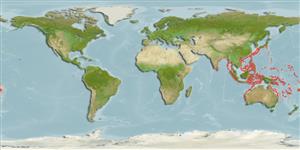
Western Pacific: Philippines and around Indonesia, north to Taiwan and south to northern Australia; with a single specimen caught in eastern Indian Ocean, off Myanmar.
Bộ gần gũi / Khối lượng (Trọng lượng) / Tuổi
Chín muồi sinh dục: Lm ? range ? - ? cm
Max length : 9.0 cm SL con đực/không giới tính; (Ref. 116586)
Mô tả ngắn gọn
Khóa để định loại | Hình thái học | Sinh trắc học
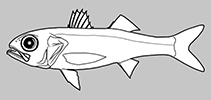
Các tia vây lưng cứng (tổng cộng) : 10; Các vây lưng mềm (tổng cộng) : 9; Tia cứng vây hậu môn: 2; Tia mềm vây hậu môn: 7. This moderately deep-bodied species is distinguished by the following characters: convex dorsal head profile; A II + 7; pectoral-fin rays 14-16 rays with pectoral length 24-28.5% SL; gill rakers 16-20; pseudobranchial filaments broad 15-25, increasing with size; first anal-fin pterygiophore is long, straight and slender, with narrow, hollow tip; vomer broad, triangular, rounded posteriorly, and with many granular teeth; palatine and ectopterygoid with 2-4 rows of granular teeth; tongue with long central band of densely packed granular teeth; orbital diameter 11.7-13.3% SL; absence of longitudinal ridges on preopercular lobe; otolith compact (OL:OH = 1.6-1.7) (Ref. 116586).
Body shape (shape guide): fusiform / normal.
This species was observed and collected in association with the Sakura shrimp, Lucensosergia lucens (Hansen, 1922) in Taiwan during fishing season (December-May) in mid-water trawls, together with Parascombrops yamanouei and other pelagic fishes like bregmacerotids and surface-migrating myctophids. In the Arafura Sea, it was collected in association with demersal fishes like Acropoma japonicum Günther, 1859, Malakichthys levis Yamanoue & Matsuura, 2001, Owstonia aff. Pectinifer (Myers, 1939) and Bembrops spp. at depth close to sea bottom but not far from a major drop-off. (Ref. 116586).
Vòng đời và hành vi giao phối
Chín muồi sinh dục | Sự tái sinh sản | Đẻ trứng | Các trứng | Sự sinh sản | Ấu trùng
Schwarzhans, W.W. and A.M. Prokofiev, 2017. Reappraisal of Synagrops, Günther, 1887 with rehabilitation and revision of Parascombrops Alcock, 1889 including description of seven new species and two new genera (Perciformes: Acropomatidae). Zootaxa 4260(1):1-74. (Ref. 116586)
Tình trạng Sách đỏ IUCN (Ref. 130435: Version 2025-2 (Global))
Mối đe dọa đối với con người
Harmless
Sử dụng của con người
Các công cụ
Báo cáo đặc biệt
Tải xuống XML
Các nguồn internet
Ước tính dựa trên mô hình
Chỉ số đa dạng phát sinh loài (Tài liệu tham khảo
82804): PD
50 = 0.5001 [Uniqueness, from 0.5 = low to 2.0 = high].
Bayesian length-weight: a=0.00977 (0.00432 - 0.02212), b=3.01 (2.82 - 3.20), in cm total length, based on LWR estimates for this (Sub)family-body shape (Ref.
93245).
Mức dinh dưỡng (Tài liệu tham khảo
69278): 3.4 ±0.5 se; based on size and trophs of closest relatives
Sự dễ bị tổn thương của nghề đánh cá (Ref.
59153): Low vulnerability (10 of 100).
🛈