Classificatie / Namen
Lokale namen | Synoniemen | Catalog of Fishes(Genus, Soort(en)) | ITIS | CoL | WoRMS | Cloffa
>
Cypriniformes (Carps) >
Leuciscidae (Minnows) > Leuciscinae
Etymology: Pseudophoxinus: Greek, pseudes = false + Greek, phoxinos = a certain river fish (Ref. 45335); mehmeti: Named after Mehmet Ekmekçi who contributed to studies in hydrological description and characterisation, and interpretations of drainage networks and watersheds, in addition to his full support as the husband of the first author.
Eponymy: Mehmet Ekmekçi is a hydrogeologist, and the husband of the first author. (Ref. 128868), visit book page.
Milieu: milieu / Klimaatzone / Diepte / verspreidingsgebied
Ecologie
; zoet water benthopelagisch. Subtropical
Asia: Alanköy basin in Burdur Province, Turkey.
Grootte / Gewicht / Leeftijd
Maturiteit: Lm ? range ? - ? cm
Max length : 7.3 cm SL mannelijk / geslacht onbekend; (Ref. 121692); max. gepubliceerd gewicht: 10.93 g (Ref. 121692)
Korte beschrijving
Determinatiesleutels | Morfologie | Morfometrie
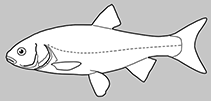
Dorsale zachte stralen (totaal) : 9 - 10; Anale zachte stralen: 9 - 10. A species closely related to the P. meandri species group, but differs from all other species of Pseudophoxinus (P. burduricus, P. evliyae, P. maeandricus, P. maeandi, P. ninae and P. bataligilae) in adjacent regions by the following unique combination of characters: body depth at dorsal-fin origin 19.1-23.4 % SL; head length 26.9-31.4 % SL, its length 1.3-1.5 times in body depth, slender, narrow; caudal-peduncle length 1.6-2.0 times its depth; mouth almost superior, without a chin; lower lip projecting slightly beyond upper lip in most specimens; tip of mouth cleft at approximately level of middle of pupil; snout pointed , its length equal or greater than eye diameter; lateral line incomplete, with 30-50 perforated scales and 48-60+2 scales in lateral series; 11½-13½ scale rows between lateral line and dorsal-fin origin; 3-5½ scale rows between lateral line and anal-fin origin; a distinct black epidermal stripe from eye to caudal-fin base in preserved individuals, absent in living individuals; preoperculo-mandibular (CPM) and infraorbital (CIO) sensory canals disconnected, supraorbital canal (CSO) with 9-13 pores, CIO with 15-18 pores, CPM with 16-19 pores, and supratemporal canal (CST) with 14-16 pores (Ref. 115532).
Body shape (shape guide): elongated.
Levenscyclus en paargedrag
Maturiteit | Voortplanting | Paaien | Eieren | Fecunditeit | Larven
Ekmekçi, F.G., M.A. Atalay, B. Yoğurtçuoğlu, D. Turan and F. Küçük, 2016. A new species of Pseudophoxinus (Teleostei: Cyprinidae) from Southwestern Anatolia, Turkey. Zootaxa 4033(1):117-128. (Ref. 115532)
Status op de Rode Lijst van het IUCN (Ref. 130435: Version 2025-2 (Global))
Gevaar voor de mens
Harmless
Gebruik door de mens
Tools
Speciale rapporten
Download XML
Internetbronnen
Schattingen op basis van modellen
Fylogenetische diversiteitsindex (Ref.
82804): PD
50 = 0.5000 [Uniqueness, from 0.5 = low to 2.0 = high].
Bayesian length-weight: a=0.01000 (0.00506 - 0.01977), b=3.14 (2.98 - 3.30), in cm total length, based on LWR estimates for this species & Genus-body shape (Ref.
93245).
Trofisch niveau (Ref.
69278): 2.7 ±0.3 se; based on size and trophs of closest relatives
Weerstandsvermogen (Ref.
120179): Hoog, minimale populatieverdubbelingstijd minder dan 15 maanden (Preliminary K or Fecundity.).
Kwetsbaarheid van de visserij (Ref.
59153): Low vulnerability (10 of 100).
🛈