Classificação / Nomes
Nomes comuns | Sinónimos | Catalog of Fishes(Género, Espécies) | ITIS | CoL | WoRMS | Cloffa
>
Siluriformes (Catfishes) >
Auchenipteridae (Driftwood catfishes) > Centromochlinae
Etymology: Ferrarissoaresia: Named after C. Ferrarris and Soares; ferrarisi: Named for C. J. Ferraris Jr., for his numerous contributions to the systematics of Siluriformes, especially Auchenipteridae, including the first hypothesis recognizing Centromochlinae as sister to all other Auchenipteridae.
Eponymy: Dr Luisa Maria Sarmento-Soares Porto is an ichthyologist at the Museu de Bologia. [...] Dr Carl James Ferraris Jr (d: 1950) is an American ichthyologist and fish taxonomist who is a recognised authority on catfish. [...] (Ref. 128868), visit book page.
Ambiente: milieu / zona climática / intervalo de profundidade / gama de distribuição
Ecologia
; Água doce demersal; intervalo de profundidade 0 - 1 m (Ref. 104786). Tropical
South America: Rio das Balsas, Rio Tocantins basin in Brazil.
Tamanho / Peso / Idade
Maturidade: Lm ? range ? - ? cm
Max length : 7.1 cm SL macho/indeterminado; (Ref. 104786)
Descrição breve
Chaves de identificação | Morfologia | Morfometria
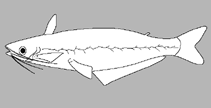
Espinhos dorsais (total) : 2; Raios dorsais moles (total) : 5; Raios anais moles: 10; Vértebras: 35. Centromochlus ferrarisi can be diagnosed from all species of Centromochlinae, with the exception of C. meridionalis by having dorsal and lateral surfaces of head and body darkly mottled with many small rounded blotches, blotches closely spaced, often coalescent and rather poorly delimited on a pale background (v. dorsolateral surfaces either uniformly dusky or dark, with pale blotches on a darker background, or with a few large dark
blotches or spots well spaced and well defined on a pale background). It can be distinguished from C. meridionalis by having the dorsal-fin spine with serrations anteriorly and smooth posteriorly (v. dorsal-fin spine smooth anteriorly and with serrations
posteriorly), seven branched anal-fin rays of mature males (v. six) and posterior nuchal
plate short, not extended anteroventrally (v. posterior nuchal plate with anteroventral
extension). It further differs from C. altae, C. existimatus, C. heckelii, C. meridionalis, C. perugiae, C. reticulatus and C. romani by possessing seven branched anal-fin rays (v. five or six); from C. macracanthus and C. schultzi by having short pectoral-fin spine, c. 15% of SL (v. long pectoral-fin spine, 25% of SL); from C. concolor and C. punctatus by its short posterior cleithral process, c. 5% of SL (v. c. 20% of SL); from C. altae, C. existimatus, C. heckelii and C. perugiae by the absence of the anterior nuchal plate (v. presence); from C. romani by having anterior margin of dorsal-fin spine with serrations (v. smooth); from C. simplex by having adipose fin well developed (v. minute) (Ref. 104786).
Body shape (shape guide): fusiform / normal.
The type locality is a small headwater stream with width of 1-1.5 m, depth of 0.3-1.0 m, moderate current and bottom composed of sand-silt and pebbles in some stretches. Collected near submerged logs, and caught by overturning a log with the hand-net positioned immediately below. Occurs syntopically with Knodus cf. savannensis (Characidae), two species of Phenacorhamdia (Heptapteridae), and Melanorivulus cf. zygonectes (Rivulidae) (Ref. 114786).
Ciclo de vida e comportamento de acasalamento
Maturidade | Reprodução | Desova | Ovos | Fecundidade | Larvas
Birindelli, J.L.O., L.M. Sarmento-Soares and F.C.T. Lima, 2015. A new species of Centromochlus (Siluriformes, Auchenipteridae, Centromochlinae) from the middle Rio Tocantins basin, Brazil. J. Fish Biol. 87(4):860-875. (Ref. 104786)
Categoria na Lista Vermelha da IUCN (Ref. 130435: Version 2025-2 (Global))
Ameaça para o homem
Harmless
Utilização humana
Pescarias: sem interesse
Ferramentas
Relatórios especiais
Descarregue XML
Fontes da internet
Estimativas baseadas em modelos
Índice de diversidade filogenética (Ref.
82804): PD
50 = 0.7500 [Uniqueness, from 0.5 = low to 2.0 = high].
Bayesian length-weight: a=0.01122 (0.00514 - 0.02450), b=3.04 (2.87 - 3.21), in cm total length, based on all LWR estimates for this body shape (Ref.
93245).
Nível Trófico (Ref.
69278): 3.3 ±0.4 se; based on size and trophs of closest relatives
Resiliência (Ref.
120179): Elevada, tempo mínimo de duplicação da população menor que 15 meses (Preliminary K or Fecundity.).
Vulnerabilidade da pesca (Ref.
59153): Low vulnerability (10 of 100).
🛈