Classificatie / Namen
Lokale namen | Synoniemen | Catalog of Fishes(Genus, Soort(en)) | ITIS | CoL | WoRMS | Cloffa
>
Cypriniformes (Carps) >
Botiidae (Pointface loaches) > Leptobotiinae
Etymology: micra: From the Greek micros, meaning small, in reference to the fact that the species is the smallest known
species of the genus, with females as small as 4.5 cm SL developing oocytes. An adjective.
Milieu: milieu / Klimaatzone / Diepte / verspreidingsgebied
Ecologie
; zoet water demersaal. Subtropical
Asia: upper River Li in Guangxi province, China.
Grootte / Gewicht / Leeftijd
Maturiteit: Lm ? range ? - ? cm
Max length : 5.0 cm SL mannelijk / geslacht onbekend; (Ref. 116421)
Korte beschrijving
Determinatiesleutels | Morfologie | Morfometrie
Dorsale zachte stralen (totaal) : 11 - 12; Anale zachte stralen: 8; Wervels: 38. Leptobotia micra is diagnosed from all its congeners by a combination of the following
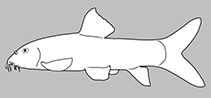
characters: absence of dark bars or dorsal saddles on body; a row of white dots along dorsal midline; 4+34 vertebrae; predorsal distance 58.1-59.0% SL; eye diameter 1.8?2.0% SL; pelvic fins not reaching anus; caudin fin emarginate (length of median rays 1.3?1.4 times in length of lower lobe); and the anus positioned distinctly closer to anal-fin origin than to pelvic-fin base (Ref. 116421).
Body shape (shape guide): elongated.
Levenscyclus en paargedrag
Maturiteit | Voortplanting | Paaien | Eieren | Fecunditeit | Larven
Bohlen, J. and V. Slechtová, 2017. Leptobotia micra, a new species of loach (Teleostei: Botiidae) from Guilin, southern China. Zootaxa 4250(1):90-100. (Ref. 116421)
Status op de Rode Lijst van het IUCN (Ref. 130435: Version 2025-2 (Global))
Gevaar voor de mens
Harmless
Gebruik door de mens
Tools
Speciale rapporten
Download XML
Internetbronnen
Schattingen op basis van modellen
Fylogenetische diversiteitsindex (Ref.
82804): PD
50 = 0.5000 [Uniqueness, from 0.5 = low to 2.0 = high].
Bayesian length-weight: a=0.00759 (0.00331 - 0.01740), b=3.04 (2.86 - 3.22), in cm total length, based on LWR estimates for this Genus-body shape (Ref.
93245).
Trofisch niveau (Ref.
69278): 3.2 ±0.4 se; based on size and trophs of closest relatives
Kwetsbaarheid van de visserij (Ref.
59153): Low vulnerability (10 of 100).
🛈