Klassificering / Namn
Populärnamn | synonymer | Catalog of Fishes(Släkte, Arter) | ITIS | CoL | WoRMS | Cloffa
>
Cypriniformes (Carps) >
Cobitidae (Spined loaches)
Etymology: Lepidocephalichthys: Greek, lepas = limpet + Greek, ichtys = fish (Ref. 45335); eleios: From the classical Greek έλειος heleios, el eleios, which h means 'of the marsh', 'dwelling in the marsh'. A noun in apposition.
Miljö: miljö / Klimatzon / djupintervall / distributionsområde
Ekologi
; sötvatten bottenlevande. Tropical
Asia: Lake Indawgyi basin, Kachin State, Myanmar.
Storlek / Vikt / Ålder
Könsmognad: Lm ? range ? - ? cm
Max length : 2.3 cm SL hane/ej könsbestämd; (Ref. 117200)
Kort beskrivning
Bestämningsnycklar | Morfologi | Morfometri
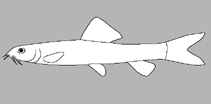
Mjukstrålar i ryggfenan (totalt) : 10; Mjukstrålar i analfenan: 8. Lepidocephalichthys eleios differs from all its congeners by lacking any modifications of the pectoral-fin rays in males. Pectoral fin has 7-8 rays which are adjacent with narrow or without membrane between them and in males, these are separate, not fused and have no dorsal or ventral projections. This species is also distinguished from congeners by the following characters, but not unique to it: body with irregular midlateral row of irregularly set small spots, sometimes forming a stripe; body with middorsal row of 9-12 saddles, reaching downwards to about ¼ of body depth, sometimes regular, sometimes irregularly shaped and of unequal density, wider than interspaces; arched black band at base of principal caudal-fin rays (no ocellus or black spot at caudal-fin base); caudal fin with pigments on rays and membranes forming 2-3 very irregular bars, posterior one along distal margin, bars irregularly in contact or fused, leaving variously shaped unpigmented patches; postlabial flange very long and narrow; head scaleless; caudal fin truncate to slightly emarginate (Ref. 117200).
Body shape (shape guide): elongated.
Facultative air-breathing in the genus (Ref. 126274); Three sampling sites of this species are characterized by deep water, very slow current, dense shore vegetation, large extents of floating mats of plants, and bottom composed of mud or clay covered with a layer of vegetal debris. Collected from leaf litter, from among the dense vegetation or by scraping the underside of the 'floating' vegetation using a tray net . The following fish species were collected in the same micro-habitat: Oreichthys sp., Pethia erythromycter, Heteropneustes fossilis, Chaudhuria sp., Mastacembelus pantherinus, Monopterus cuchia, Indostomus paradoxus, Badis corycaeus, Dario hysginon (Ref. 117200).
Livscykel och parningsbeteende
Könsmognad | Reproduktion | Lek | Ägg | Fekunditet | Larver
Kottelat, M., 2017. Lepidocephalichthys eleios, a new loach from Lake Indawgyi basin, Kachin State, Myanmar (Teleostei: Cobitidae). Raffles Bulletin of Zoology 65:707-714. (Ref. 117200)
Status på IUCN:s rödlista (Ref. 130435: Version 2025-2 (Global))
Hot mot människor
Harmless
Mänskliga användningsområden
Verktyg
Särskilda rapporter
Ladda ner XML
Internet-källor
Uppskattningar baserade på modeller
Index för fylogenetisk mångfald (Ref.
82804): PD
50 = 0.5000 [Uniqueness, from 0.5 = low to 2.0 = high].
Bayesian length-weight: a=0.00617 (0.00276 - 0.01377), b=3.08 (2.91 - 3.25), in cm total length, based on LWR estimates for this Genus-body shape (Ref.
93245).
Trofisk nivå (Ref.
69278): 3.0 ±0.3 se; based on size and trophs of closest relatives
Resiliens (Ref.
120179): Hög, lägsta populationsfördubblingstid mindre än 15 månader (Preliminary K or Fecundity.).
Sårbarhet i fisket (Ref.
59153): Low vulnerability (10 of 100).
🛈