>
Gobiiformes (Gobies) >
Gobiidae (Gobies) > Gobionellinae
Etymology: Pomatoschistus: Greek, poma, -atos = cover, operculum + Greek, schistos = divided (Ref. 45335); nanus: Name derive from ancient Greek which means pygmaean.
Entorno: milieu / zona climática / rango de profundidad / gama de distribución
Ecología
marino pelagic-neritic; rango de profundidad 29 - 41 m (Ref. 117534). Subtropical
Mediterranean: Turkey.
Tamaño / Peso / Edad
Madurez: Lm ? range ? - ? cm
Max length : 1.7 cm SL macho / no sexado; (Ref. 117534)
Descripción breve
Claves de identificación | Morfología | Morfometría
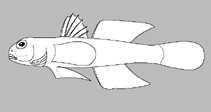
Espinas dorsales (total) : 7; Radios blandos dorsales (total) : 8; Espinas anales: 1; Radios blandos anales: 9 - 10. This species is distinguished by the following characters: suborbital papilla of longitudinal row a anteriorly passing the pupil and with one transverse row atp; 6 transverse suborbital rows; naked predorsal area, first dorsal-fin base and breast; anterior point of suborbital row b not reaching the level of posterior point of the suborbital row d; anterior and posterior oculoscapular canals and preopercular canals are present but ?, ?, ? pores are missing in all specimens; caudal fin is slightly emarginated; colour pattern of the nape with 2 elongated brown and parallel stripes on the nape and a brown blotch beginning at the posterior edge of the eye that slightly extends to upper border of the preopercle (Ref. 117534).
Body shape (shape guide): fusiform / normal; Cross section: oval.
Occurs on coarse white sand where the base of rocky reefs merged with the sand or in pools of sand. The species was observed in groups of 15-20 individuals which are either on bottom or hovering approximately 10-30 cm over the substratum. The most common syntopic fish species observed in the area were Gobius geniporus, Thorogobius macrolepis, Epinephelus marginatus, Epinephelus costae and Lessepsian migrant Torquigener flavimaculosus which were also at high abundances in the area (Ref. 117534).
Ciclo vital y comportamiento de apareamiento
Madurez | Reproducción | Puesta | Huevos | Fecundidad | Larva
Engin, S. and D. Seyhan, 2017. A new species of Pomatoschistus (Teleostei, Gobiidae): the Mediterranean’s smallest marine fish. J. Fish Biol. 91(4):1208-1223. (Ref. 117534)
Situación en la Lista Roja de la UICN (Ref. 130435: Version 2025-2 (Global))
Amenaza para el ser humano
Harmless
Usos humanos
Herramientas
Informes especiales
Descargar XML
Fuentes de Internet
Estimaciones basadas en modelos
Índice de diversidad filogenética (Referencia
82804): PD
50 = 0.5001 [Uniqueness, from 0.5 = low to 2.0 = high].
Bayesian length-weight: a=0.01023 (0.00452 - 0.02316), b=3.00 (2.81 - 3.19), in cm total length, based on LWR estimates for this (Sub)family-body shape (Ref.
93245).
Nivel trófico (Referencia
69278): 3.0 ±0.3 se; based on size and trophs of closest relatives
Resiliencia (Referencia
120179): Alto, población duplicada en un tiempo mínimo inferior a 15 meses (Preliminary K or Fecundity.).
Vulnerabilidad pesquera (Ref.
59153): Low vulnerability (10 of 100).
🛈