>
Gobiiformes (Gobies) >
Gobiidae (Gobies) > Gobiinae
Etymology: Thorogobius: Greek, thoros = semen + Latin, gobius = gudgeon (Ref. 45335); laureatus: Name from Latin 'laureatus' meaning crowned with a laurel; referring to the shape of the scaled areas in the predorsal region.
Eponymy: These genera and species are named after ‘Thor’, the first Danish research vessel specifically equipped for oceanic scientific research (named after the Norse god of thunder). [...] (Ref. 128868), visit book page.
Ambiente: milieu / zona climatica / distribuzione batimetrica / gamma di distribuzione
Ecologia
marino pelagic-neritic; distribuzione batimetrica 57 - 109 m (Ref. 118185). Tropical
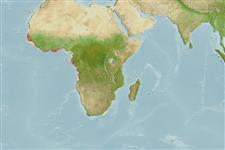
Eastern Atlantic: Angola and São Tomé and Príncipe.
Dimensione / Peso / Età
Maturità: Lm ? range ? - ? cm
Max length : 7.4 cm SL maschio/sesso non determinato; (Ref. 118185); 8.0 cm SL (female)
Breve descrizione
Chiavi di identificazione | Morfologia | Morfometria
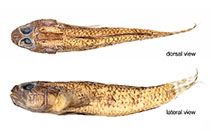
Spine dorsali (totale) : 7; Raggi dorsali molli (totale) : 11; Spine anali: 1; Raggi anali molli: 10; Vertebre: 28. This species is distinguished from its congeners in the combination of following characters: D1 VI (second and third distinctly elongated); pectoral fin rays 19-22; short pelvic disc complete with well-developed anterior membrane (frenum), pointed lateral lobes; scales on nape and predorsal area in lateral band; opercle no scales; scales in longitudinal series 24-27; supratemporal rows tr and trp developed and extending transversally between pores H and K; longitudinal row g is long, passing row m posteriorly and relatively close to row h; infraorbital row 6 is long, ventrally extending to lower margin of preopercle, its ventral (6i) and dorsal (6s) originating opposite to each other; posterior lateral row h is long, reaching anteriorly above middle of opercle; body depth 18.9-23.8% at anal-fin origin in SL, head width 48.5-56.0% in HL; long upper jaw 41.8-58.0% in HL; minimum height of caudal peduncle 45.1-59.8% in caudal peduncle length; large eyes 23.9-30.9% in HL); long caudal fin 27.9-35.5% in SL; body pale fawn and brownish with margin of scale pockets dark brown pigmented, yielding a reticulated pattern; 5 brown blotches on flanks in lateral midline from below first dorsal fin to caudal peduncle; caudal fin with 6-7 distinct dark vertical bands (Ref. 118185).
Body shape (shape guide): elongated; Cross section: oval.
Specimens were dredged on the upper slope of the continental shelf from soft bottom (Ref. 118185).
Ciclo vitale e comportamento di accoppiamento
Maturità | Riproduzione | Deposizione | Uova | Fecondità | Larve
Sauberer, M., T. Iwamoto and H. Ahnelt, 2018. Two new deep-water species of the genus Thorogobius (Teleostei: Gobiidae) from the upper continental slope of the Eastern Central Atlantic. Zootaxa 4429(2):357-371. (Ref. 118185)
Stato della Lista Rossa IUCN (Ref. 130435: Version 2025-2 (Global))
Minaccia per l'uomo
Harmless
Usi umani
Strumenti
Rapporti speciali
Scarica XML
Fonti Internet
Stime basate su modelli
Indice di diversità filogenetica (Fonte Biblio.
82804): PD
50 = 0.5156 [Uniqueness, from 0.5 = low to 2.0 = high].
Bayesian length-weight: a=0.00741 (0.00347 - 0.01582), b=3.09 (2.91 - 3.27), in cm total length, based on LWR estimates for this (Sub)family-body shape (Ref.
93245).
Livello trofico (Fonte Biblio.
69278): 3.3 ±0.4 se; based on size and trophs of closest relatives
Resilienza (Fonte Biblio.
120179): Alto, tempo minimo di raddoppiamento della popolazione meno di 15 mesi (Preliminary K or Fecundity.).
Vulnerabilità della pesca (Ref.
59153): Low vulnerability (10 of 100).
🛈