分类 / 名称
俗名 | 同种异名 | Catalog of Fishes(属, 种) | ITIS | CoL | WoRMS | Cloffa
Teleostei >
Syngnathiformes (Pipefishes and seahorses) >
Syngnathidae (Pipefishes and seahorses) > Syngnathinae
Etymology: Hippocampus: Greek, ippos = horse + Greek,kampe = curvature (Ref. 45335); haema: Name from Korean word Haema meaning ‘seahorse’, which connotes ‘representative’ and ‘common’; chosen to indicate that this seahorse is the one most commonly found in Korea.
环境:氛围 / 气候带 / 深度上下限 / 分布范围
生态学
海洋 礁区鱼类; 非迁移的; 深度上下限 0 - 18 m (Ref. 117115).
分布
领土 | FAO区域 | 生态系 | 标本纪录 | 分布图 | 简介 | Faunafri
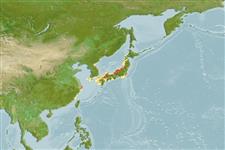
Northwestern Pacific: Korea and Japan.
大小 / 重量 / 年龄
成熟度: Lm ? range ? - ? cm
Max length : 11.4 cm SL 雄鱼/尚未辨别雌雄; (Ref. 117115)
简单描述
检索表 | 型态特徵 | 形态测量图
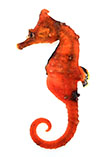
This species is distinguished by the following characters: bony body; double gill openings; R 10 + 35-38, mode 10 + 36 (holotype with 10 + 36); coronet is moderately high and turned back on top; CoT 4; CHGO 22.7-41.6 % HL; CHMC 34.1-54.9 % HL; a wing-tip spine (thick-recurved) on the dorsal fin base (Ref. 117115).
Body shape (shape guide): other (see remarks); Cross section: other (see remarks).
Lives in floating Sargassum and weeds on shallow soft bottom habitats (Ref. 117115).
生命周期和交配行为
成熟度 | 繁殖 | 产卵场 | 卵 | 孕卵数 | 仔鱼
Han, S.-Y., J.-K. Kim, Y. Kai and H. Senou, 2017. Seahorses of the Hippocampus coronatus complex: taxonomic revision, and description of Hippocampus haema, a new species from Korea and Japan (Teleostei, Syngnathidae). ZooKeys 712:113-139. (Ref. 117115)
世界自然保护联盟红皮书 (Ref. 130435: Version 2025-2 (Global))
易受伤害 (VU) (A2c); Date assessed: 14 December 2023
人类利用
工具
特别资料
下载 XML
网络资源
基于模型的估算
系统发育多样性指数 (参考文献
82804): PD
50 = 0.5000 [Uniqueness, from 0.5 = low to 2.0 = high].
Bayesian length-weight: a=0.00447 (0.00176 - 0.01132), b=3.00 (2.78 - 3.22), in cm total length, based on LWR estimates for this (Sub)family-body shape (Ref.
93245).
营养阶层 (参考文献
69278): 3.4 ±0.4 se; based on size and trophs of closest relatives
回复力 (参考文献
120179): 高度, 族群倍增时间少于 15个月 (Preliminary K or Fecundity.).
渔业脆弱性 (Ref.
59153): Low vulnerability (10 of 100).
🛈