Classification / Noms
Noms communs | Synonymes | Catalog of Fishes(Genre, Espèce) | ITIS | CoL | WoRMS | Cloffa
>
Siluriformes (Catfishes) >
Aspredinidae (Banjo catfishes) > Aspredininae
Etymology: Amaralia: Because of Dr. Afranio de Amaral, name that was used by H.W. Fowler; personal communication of John Friell/Cornell University; oviraptor: Derived from the Latin ovum (ovi), meaning egg; and raptor, meaning a robber or plunderer, commonly used term for a predator, in reference to the peculiar dietary preferences observed in this species. A noun in apposition.
Eponymy: Dr Afranio Pompilio Bastos do Amaral (1894–1982) was a physician, zoologist, and herpetologist and was Director of Instituto Butantan (1919–1921 and 1928–1938). [...] (Ref. 128868), visit book page.
Environnement : milieu / zone climatique / profondeur / gamme de distribution
Écologie
; eau douce démersal. Tropical
South America: Paraná-Paraguay River system; throughout the Paraguay River Basin in Brazil, Paraguay and northern Argentina; and Paraná drainage in Argentina and Brazil.
Taille / Poids / Âge
Maturité: Lm ? range ? - ? cm
Max length : 12.3 cm SL mâle / non sexé; (Ref. 111083)
Description synthétique
Clés d'identification | Morphologie | Morphométrie
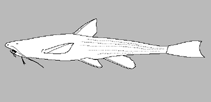
Rayons mous dorsaux (Total) : 3; Rayons mous anaux: 5 - 6; Vertèbres: 29 - 31. Amaralia oviraptor differs from its only congener, A. hypsiura, by having more dorsal-fin rays (3 vs. 2); by having a lateral contact between middle and posterior nuchal plates (vs. middle and posterior nuchal plates not contacting each other laterally); by having feeble serrations along the distal portion of the anterior margin of pectoral-fin spine (vs. absence of serrations along the anterior margin); and by its longer cleithral process (17.4-19.5 % of SL, mean 18.2 % vs. 14.0-17.2 % of SL, mean=15.5 %) (Ref. 111083).
Body shape (shape guide): elongated.
Feeds on both the eggs and developing embryos of other catfishes (Ref. 111083).
Cycle de vie et comportement reproducteur
Maturité | Reproduction | Frai | Œufs | Fécondité | Larves
Friel, J.P. and T.P. Carvalho, 2016. A new species of Amaralia Fowler (Siluriformes: Aspredinidae) from the Paraná-Paraguay river basin. Zootaxa 4088(4):531-546. (Ref. 111083)
Statut dans la liste rouge de l'IUCN (Ref. 130435: Version 2025-2 (Global))
Menace pour l'homme
Harmless
Utilisations par l'homme
Outils
Articles particuliers
Télécharger en XML
Sources Internet
Estimations basées sur des modèles
Indice de diversité phylogénétique (Réf.
82804): PD
50 = 0.7500 [Uniqueness, from 0.5 = low to 2.0 = high].
Bayesian length-weight: a=0.00324 (0.00137 - 0.00763), b=3.02 (2.81 - 3.23), in cm total length, based on LWR estimates for this (Sub)family-body shape (Ref.
93245).
Niveau trophique (Réf.
69278): 3.2 ±0.4 se; based on size and trophs of closest relatives
Vulnérabilité de la pêche (Ref.
59153): Low vulnerability (10 of 100).
🛈