Klassifizierung / Names
Namen | Synonyme | Catalog of Fishes(Gattung, Arten) | ITIS | CoL | WoRMS | Cloffa
>
Eupercaria/misc (Various families in series Eupercaria) >
Labridae (Wrasses) > Cirrhilabrinae
Etymology: Cirrhilabrus: Latin, cirrus = curl fringe + Greek, labros = furious (Ref. 45335); marinda: Named for the Bupati and Vice Bupati of Raja Ampat, Drs. Marcus Wanma and Drs. Inda Arfan; the name was a combination of the first part of their respective names, Marcus and Inda, resulting in 'marinda' ; noun in apposition.
Umwelt: Milieu / Klimazone / Tiefenbereich / Verbreitungsgebiet
Ökologie
seewasser riff-verbunden; tiefenbereich 25 - 40 m (Ref. 103842). Tropical
Verbreitung
Territorien | FAO Gebiete | Ökosysteme | Vorkommen | Punkt Karte | Einführungen | Faunafri
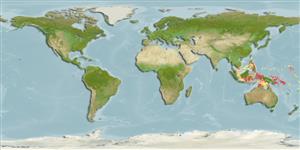
Western Pacific: from eastern Indonesia at Halmahera (Morotai Island) and West Papua (Ayau Atoll) and Vanuatu; photos from Papu New Guinea (Manus I.).
Größe / Gewicht / Alter
Geschlechtsreife: Lm ? range ? - ? cm
Max length : 4.6 cm SL Männchen/unbestimmt; (Ref. 103842)
Kurzbeschreibung
Bestimmungsschlüssel | Morphologie | Morphometrie
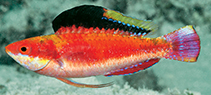
Rückenflossenstacheln (insgesamt) : 9; Rückenflossenweichstrahlen (insgesamt) : 9; Afterflossenstacheln: 3; Afterflossenweichstrahlen: 9. This species is distinguished by the following characters: D XI,9; A III,9; pectoral-fin rays usually 15 (occasionally 16); lateral-line scales 15-17 + 6-9; median predorsal scales 4-6; a single horizontal scale rows on cheek below eye; gill rakers 13-16 (usually 14); body depth 2.9-3.5 in SL; head length 2.8-3.1 in SL; snout length 3.7-4.5 in HL; the caudal fin is rounded; male pelvic fins elongate and reaching posteriorly to about middle of anal fin, 2.2-2.9 in SL; colour of male in life mainly bright red to orange on upper one half to two-thirds of head and body, often with an orange wash on nape and diffuse orange zone between dorsal-fin origin and upper pectoral-fin base; the head and body abruptly white to pale greyish on lower third; dorsal fin with white basal stripe and broad black band covering most of spinous part of fin, tapering in width posteriorly to end of soft dorsal, the outer half of soft dorsal translucent yellowish with row of blue spots between black and translucent portions; anal fin is white basally and remainder of fin bright red except row of blue spots between white and red portions and narrow blue outer margin; the caudal fin red medially with 2-3 transverse rows of small blue spots, dorsalmost and ventralmost fourths of fin yellowish; female and juvenile in life mainly yellowish anteriorly on head and body, grading to pinkish on remainder of body except belly and lower half of head whitish; presence of about 6-7 narrow white to bluish stripes on upper half of head (including snout), continuing on side of body (corresponding with lateral scale rows) to caudal-fin base; the fins are mainly pale grey to pinkish except dorsal fin with broad yellow basal stripe and dark grey to blackish on remainder of spinous portion (Ref. 103842).
Body shape (shape guide): fusiform / normal; Cross section: compressed.
Occurs in flat or gently sloping areas, mixed Halimeda sand and rubble bottoms with scattered, low outcrops of rock or coral, usually on exposed outer reefs with periodic strong currents. The species appears to be common at Ayau Atoll and typically occurs in groups of about 10-20 individuals, the majority of which are initial phase fish (Ref. 103842).
Lebenszyklus und Paarungsverhalten
Geschlechtsreife | Fortpflanzung | Ablaichen | Eier | Fruchtbarkeit | Larven
Allen, G.R., M.V. Erdmann and M. Dailami, 2015. Cirrhilabrus marinda, a new species of wrasse (Pisces: Labridae) from eastern Indonesia, Papua New Guinea, and Vanuatu. J. Ocean Sci. Found. 15:1-1-15. (Ref. 103842)
IUCN Rote Liste Status (Ref. 130435: Version 2025-2 (Global))
Bedrohung für Menschen
Harmless
Nutzung durch Menschen
Tools
Zusatzinformationen
Download XML
Internet Quellen
Schätzungen auf der Grundlage von Modellen
Phylogenetischer Diversitätsindex (Ref.
82804): PD
50 = 0.5000 [Uniqueness, from 0.5 = low to 2.0 = high].
Bayesian length-weight: a=0.01072 (0.00427 - 0.02691), b=3.03 (2.81 - 3.25), in cm total length, based on LWR estimates for this (Sub)family-body shape (Ref.
93245).
Trophische Ebene (Ref.
69278): 3.2 ±0.4 se; based on size and trophs of closest relatives
Widerstandsfähigkeit (Ref.
120179): hoch, Verdopplung der Population dauert weniger als 15 Monate. (Preliminary K or Fecundity.).
Anfälligkeit der Fischerei (Ref.
59153): Low vulnerability (10 of 100).
🛈