>
Eupercaria/misc (Various families in series Eupercaria) >
Labridae (Wrasses) > Cirrhilabrinae
Etymology: Cirrhilabrus: Latin, cirrus = curl fringe + Greek, labros = furious (Ref. 45335); rubeus: Name for Latin 'rubeus' for red, derived from the name of the bramble bush which bears red raspberries, referring to its bright red color; a masculine nominative singular adjective of the second
declension.
Environnement : milieu / zone climatique / profondeur / gamme de distribution
Écologie
marin récifal. Tropical
Central Indian Ocean: from Sri Lanka and the Maldives.
Taille / Poids / Âge
Maturité: Lm ? range ? - ? cm
Max length : 5.4 cm SL mâle / non sexé; (Ref. 114940)
Description synthétique
Clés d'identification | Morphologie | Morphométrie
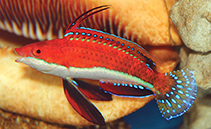
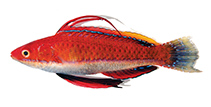
Épines dorsales (Total) : 11; Rayons mous dorsaux (Total) : 9; Épines anales: 3; Rayons mous anaux: 9. This species is distinguished by the following characters: D XI,9; A III,9; pectoral-fin rays 15; pored lateral-line scales 15-17 + 6-8 (+1 over caudal-fin base); median predorsal scales 3-4; cheek with 5 or 6 scales in single row, just below eye; with uniserial row of suborbital pores; gill rakers 13-15. Morphometrics for males in terminal phase: body depth 3.7-3.8 in SL; body width in depth 2.0; head length 3.0-3.4 in SL; first two dorsal-fin spinous membranes are greatly elongated and filamentous, 1.6-3.4 and 1.3-3.0 in SL, respectively; rounded caudal fin with extended upper and lower tips, 1.1-1.3 in HL; pelvic fins greatly elongated and broadly fan-like, reaching posteriorly to about middle of anal fin, 2.0-2.1 in SL; upper head and body bright red to red-orange, divided from whitish lower head and body by a usually unbroken, bluish to lavender full-length stripe; anterior part of dorsal fin reddish, rear of fin dark basally and yellowish distally (variable extent of yellow on fin), divided mid-way out by a dark-outlined blue stripe breaking into spots (after a variable distance) posteriorly; caudal fin with blue-green sheen and numerous small bluish spots and lines; anal fin is reddish to dark with an often incomplete row of bluish spots near base of fin; pelvic fins are greatly elongated and mostly red on outer portion and mostly black on inner rays, with black streaks typically extending full length, with black fin tips (Ref. 114940).
Body shape (shape guide): fusiform / normal; Cross section: compressed.
Cycle de vie et comportement reproducteur
Maturité | Reproduction | Frai | Œufs | Fécondité | Larves
Victor, B.C., 2016. Two new species in the spike-fin-fairy-wrasse species complex (Teleostei: Labridae: Cirrhilabrus) from the Indian Ocean. J. Ocean Sci. Found. 23:21-50. (Ref. 114940)
Statut dans la liste rouge de l'IUCN (Ref. 130435: Version 2025-2 (Global))
Menace pour l'homme
Harmless
Utilisations par l'homme
Pêcheries: commercial; Aquarium: Commercial
Outils
Articles particuliers
Télécharger en XML
Sources Internet
Estimations basées sur des modèles
Indice de diversité phylogénétique (Réf.
82804): PD
50 = 0.5000 [Uniqueness, from 0.5 = low to 2.0 = high].
Bayesian length-weight: a=0.01072 (0.00427 - 0.02691), b=3.03 (2.81 - 3.25), in cm total length, based on LWR estimates for this (Sub)family-body shape (Ref.
93245).
Niveau trophique (Réf.
69278): 3.3 ±0.4 se; based on size and trophs of closest relatives
Résilience (Réf.
120179): Haut, temps minimum de doublement de population inférieur à 15 mois (Preliminary K or Fecundity.).
Vulnérabilité de la pêche (Ref.
59153): Low vulnerability (10 of 100).
🛈