>
Gobiiformes (Gobies) >
Microdesmidae (Wormfishes) > Ptereleotrinae
Etymology: Navigobius: Name from Latin ' navi' meaning to float or swim, an allusion to the swimming habits of the species; vittatus: Name from Latin 'vittatus' for blue stripes on the dorsal fins.
Ambiente: milieu / zona climatica / distribuzione batimetrica / gamma di distribuzione
Ecologia
marino associati a barriera corallina; distribuzione batimetrica 25 - 31 m (Ref. 105381). Tropical
Western Pacific: Brunei Darussalam.
Dimensione / Peso / Età
Maturità: Lm ? range ? - ? cm
Max length : 2.3 cm SL maschio/sesso non determinato; (Ref. 105381)
Breve descrizione
Chiavi di identificazione | Morfologia | Morfometria
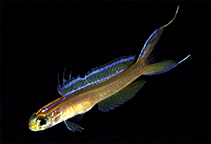
Spine dorsali (totale) : 7; Raggi dorsali molli (totale) : 11 - 13; Spine anali: 1; Raggi anali molli: 10 - 12; Vertebre: 26. This species is distinguished by the following characters: D VI + I,11-13 (rarely 13), the spines of first dorsal fin with protruding filaments; A I,10-12 (rarely 12); pectoral-fin rays 18-19; scales in longitudinal series 52-58; total gill rakers on first arch 15-16; segmented caudal-fin rays 17; branched caudal-fin rays 11; forked caudal fin with filament on upper and lower lobe; no preopercular pores; interorbital pores paired; colour in life semi-translucent grey with yellowish hue; with short yellow stripe on snout and from upper eye to pectoral-fin base; blue stripe from mid-interorbital to first dorsal-fin origin; dorsal fins are translucent with yellowish hue, both dorsal fins have prominent basal and submarginal blue stripes; caudal fin yellowish to yellow-brown with blue upper and lower margins (Ref. 105381).
Body shape (shape guide): elongated; Cross section: compressed.
Form loose aggregations of 10-50 individuals, observed hovering 50-100 cm above the substrate on a very gradual but strongly current-swept sand and rubble slope in 28-31 m depth. Collection reef with visibility invariably quite low (5-8 m maximum) and where there was frequently a minor thermocline at the 20-25 m depth range, with the fish exposed to moderately cooler temperatures down to 27°C. When approached too closely, individuals would dive into burrows in the sand, sometimes individually but also multiple individuals entering the same burrow (Ref. 105381).
Ciclo vitale e comportamento di accoppiamento
Maturità | Riproduzione | Deposizione | Uova | Fecondità | Larve
Allen, G.R., M.V. Erdmann and N.K.D. Cahyani, 2015. Navigobius vittatus, a new species of dartfish (Gobiidae: Ptereleotrinae) from Brunie Darussalam. J. Ocean Sci. Found. 17:12-21. (Ref. 105381)
Stato della Lista Rossa IUCN (Ref. 130435: Version 2025-2 (Global))
Minaccia per l'uomo
Harmless
Usi umani
Strumenti
Rapporti speciali
Scarica XML
Fonti Internet
Stime basate su modelli
Indice di diversità filogenetica (Fonte Biblio.
82804): PD
50 = 0.5625 [Uniqueness, from 0.5 = low to 2.0 = high].
Bayesian length-weight: a=0.00389 (0.00180 - 0.00842), b=3.12 (2.94 - 3.30), in cm total length, based on all LWR estimates for this body shape (Ref.
93245).
Livello trofico (Fonte Biblio.
69278): 3.1 ±0.4 se; based on size and trophs of closest relatives
Vulnerabilità della pesca (Ref.
59153): Low vulnerability (10 of 100).
🛈